Friday, November 5, 2010

Mr. Ridge's class Blog from Grampa Al

Anyone want nuts?
Famous mosque of Jezzar Pasha
Whose car is this?
   Do you have a cat?  There are a lot of cats in Acre, which the Arabs call "Acca," and the Israelis call "Acco."  The city must be confused!  If it could speak, what would it say its name is?
The old city from the sea
Looking into the old city
   Acre is a very old city.  Back in the twelfth century, Crusaders England,  France and Germany came here to capture the city .        Crusaders were knights - fighters - who believed that if they went to "the holy land," the land where Christ was born and crucified, and got it back from the Arab Muslims who controlled it, they would go to heaven.  Of course it was also a "holy land" for Muslims, as it was for Jews.  The first Crusaders captured Acre, then the Arabs recaptured it and then the next Crusaders captured it, and eventually, in the sixteenth century, the Ottoman fighters - the Ottomans were Turks, the people of what is today Turkey - captured Acre and the rest of this area, including Jerusalem.  And on it goes.  This is an area that has been alive in history for over 2000 years!  The old city of Acre, where I am staying with friends, is over 350 years old.  Here are some pictures of Acre from the sea and from inside the old city.  There's a new city, too, outside the walls that are 350 years old, and it's not so different from cities you know, except they speak Hebrew and Arabic and a little English.
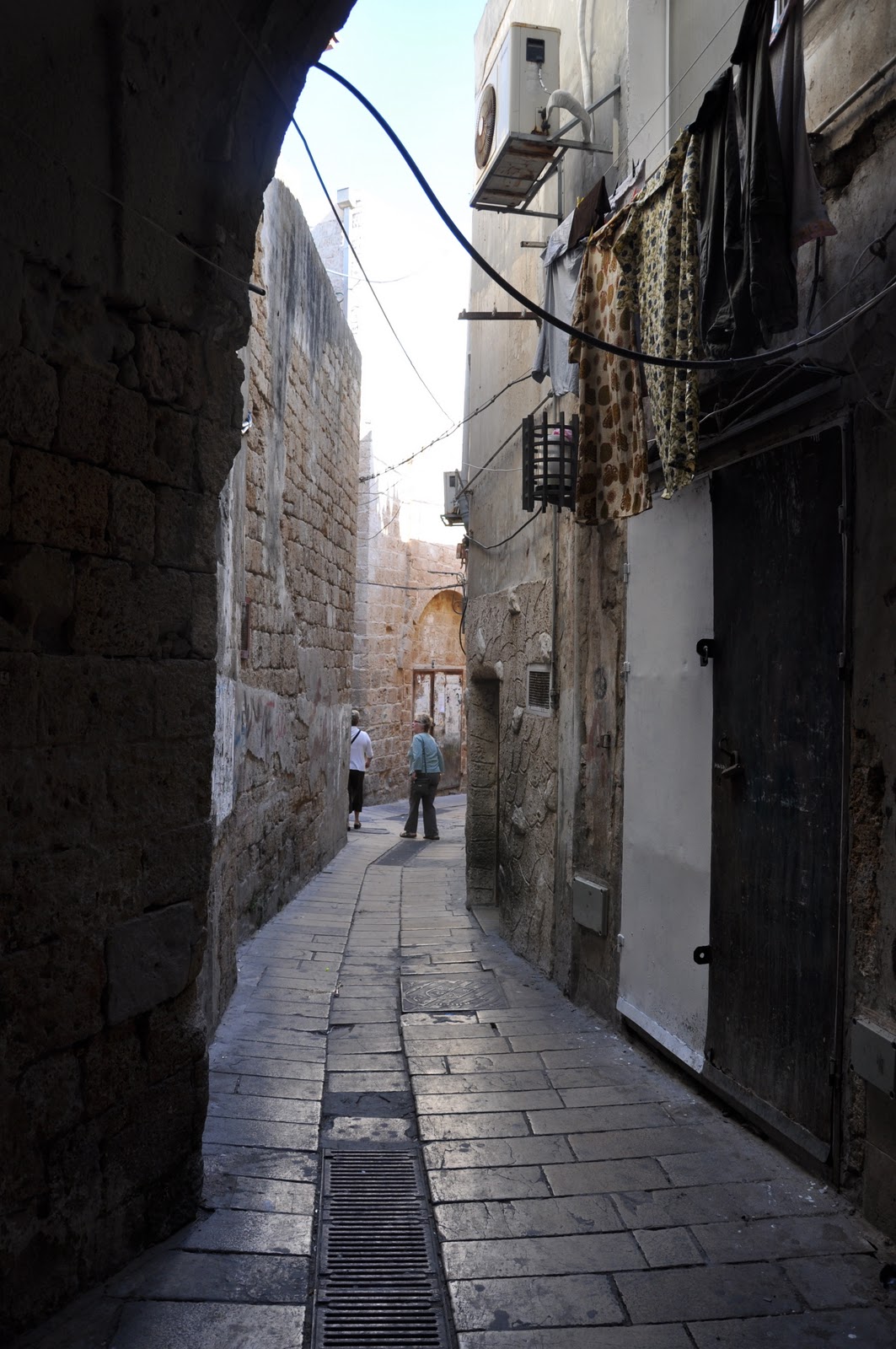
A narrow street
   Imagine, some of the buildings that have apartments like the one I'm staying in are over 300 years old.  Others are 200 years old.  When they were built, there wasn't plumbing, but now there is.  There weren't electricity, but now there is.  There wasn't television or computers or cars.  You wouldn't want to have a big car in old Acre.  It wouldn't be able to squeeze through some of the streets!
Want some fish?
    There are also markets, like there are in old Jerusalem.  Do you remember my showing some of those pictures in my blogs from Jerusalem?  Here they have old markets, too.  You wander through them looking for whatever you want or need: a pot for cooking?  a new scarf?  maybe some pomegranate juice or orange juice or some nuts mixed with honey or an Arabic sweet - have you ever tasted baclava?  Maybe you're shopping for dinner and need a chicken and some rice and some vegetables.  All these you can find in the markets of the old city.  This is the way people shopped before supermarkets!
Inside the Jezzar Pasha Mosque
There is a famous old mosque in the Acre, the old city.  A mosque is the place where Muslims go to worship, like a church for Christians and a temple for Jews.  This mosque is called the Jezzar Pasha Mosque, named after Jezzar Pasha, a famous Muslim leader in the city.  It has a tall minaret, the tower next to a mosque from the top of which a muezzin calls people to prayer, five times a day.  The best muezzins have good voices and sound like singers when they call people to prayer.  Now, many mosques use a recording and loud speakers for the call to prayer instead of having a person climb to the top of the minaret five times a day for the call to prayer.
Okay, everybody, that's today's blog.  I have to get ready for the big party.  I'll do one or two more blogs for the class before I come back.  I'll see you sometime soon after I get back to ask if you have any questions.  I hope then to know the name of a school and teacher whose class wants to exchange messages with you on the internet.  I've asked a teacher I know to try to find a fifth grade!

Acre or Acca or Acco

Entering old Acre
   Welcome to Acre, an ancient and a modern city in Israel on the coast of the Mediterranean Sea above Haifa, a bustling port city.  Acre is called "Acca" by the Palestinians, "Acco" by the Israelis.  It was a Palestinian city before the war in 1948 when Israeli troops attacked and took Acre, and 13,500 of the 17,400 Palestinian residents fled.
Mosque of Jezzar Pasha
   I'm staying in my friend Khitam's family house, which is really an apartment, in the old city, Khitam, Ahmad and some of Khitam's friends.  We're a little crowded but I think that I, as "the elder," have the best space for sleeping.  I also catch the morning sun at around 5:30 which means an early rise unless I'm very tired.  It also warms the room and lets in the sounds of this 18th century waking up.
Inside the mosque
   This city goes way back.  It was a major city of the Muslim world before the Crusaders take it in 1104.  Saladin, the great Muslim leader, took it back in 1187 and then the Richard I of England led Crusaders back to conquest in 1191.  The Knights Hospitallers took over the city in 1229 and in 1517, the Ottomans conquered the city and it became part of the Ottoman Empire which lasted until the First World War.
   It's a great city to wander in, day or night.  During the day, there are the old markets, many of them now stocked with goods from China!  However, there are still sweets and pomegranate juice freshly squeezed, and hummus and baba ghanouj  (crushed eggplant and tahini) and scarves and...and...  It's not a big market, compared to Jerusalem and Damascus and Aleppo, but it's lively and very "old Arab."
Old Acre/Acca
   The old city is still a Palestinian city, with over 90% of the population Palestinians.  It has the feel of an Arab city.  The streets of this 18th century city are a warren of turns and doorways and shops.  In 1750, the walls of the city were begun, and later in the same century, Jezzar Pasha, a powerful and popular leader, began developing the city and the mosque bearing his name was built.
City walls in the old harbor
   The narrow streets are busy with shoppers, and, in the summer, with tourists, although it is very hot in the summer.  With the sea nearby and a modern city outside the 18th century walls of the old city, Israeli tourists also come to visit.  We have seen buses of young people wandering inside the walls.
Fish in the market
Two boys putting out a net in the harbor
   The fish here is fresh and good.  Last night, we went out to eat at one of Khitam's favorite restaurants nearby.  We had fresh whole fish grilled, calamari lightly friend and shrimp grilled. It was all delicious.  Of course we had hummus and baba ghanouj again and four kinds of salad.  Khitam's sister Zada, who is in her mid sixties and a widow of twelve years, joined us.  Zada is a haji, which means she has made the pilgrimage to Mecca.  She wears a head scraf and a long dress that covers her to her shoes.  She is a strong handsome woman and sometimes I catch a clear resemblance between Khitam and Zada.  Zada is the youngest of five sisters.  There are also six brothers, so this is not a small family!  Yesterday in the market, we met four of her brothers, one of whom I had met Wednesday.  More on the family after tonight's wedding party, a small affair of 150 or so.
Wahib's shop
A show with nuts and stuff
   Because this is a walled and ancient city, you are constantly reminded of the past.  You can still see the city walls from the 18th century with their dry moat (a moat without water between the outer wall and an inner wall) and everywhere you look there are remnants of the past mixed in with the present.  I got interested in history by wandering through cities like Acre.  Before I went to the Middle East right after college 150 years ago, I thought history was a bunch of columns that you named "Doric, Ionic or Corinthian" and some dates.  Then I learned that history was stories of people who lived somewhere and if they lived here, they ate dates.
   Here you see it and feel it.  History isn't dry.  It may become dry in the classroom.  It requires imagination.  "What was it like then?  What did people do?  How did they live?  Why did they fight?"  Stories.  The buildings, the temples, the remains of markets, those are the reminders that people shopped and ate and studied and played and made art and sometimes made war and then started over again.  If we studied history more as the story of man, would we learn how to change our behavior so that we don't keep destroying the civilization we built?
Wedding photos in old Acre
   People come to the old part of the city not only to look and shop but also to get married or, in the case of the couple on the right, to be photographed.  We congratulated them - "mabrouk" - but they didn't understand the term.  A shopkeeper said they weren't the couple celebrating being married; they just came to be photographed.  They lived and were married outside the old city.  When we walked out of our "alley," we noticed a police car had come with them.  They were Jewish and Khitam guessed the police came to make sure nothing happened to them.  Khitam shook her head at that.  "What's going to happen to them here?  Nothing."
   That night, there was a very long very loud wedding party in the square for a couple from the old city.  The music blasted and teenagers in the States would have recognized the vibe.  What they would have found strange was the men sitting on one side of the square, the women on the other, and only the women dancing.  Everybody was having a great time.  The style was different but the celebration had the same "vibe."  And the music?  Too loud, as it would have often been in the States.

Thursday, November 4, 2010

"Something there is that doesn't love a wall..."

wall
prison
   Robert Frost wrote: "Something there is that doesn't love a wall..."  Palestinians?  Israelis?  He wasn't really writing for them, but art can stimulate us to reflect more deeply on issues of our time.
   When I was thinking about my coming to Palestine and Israel, I wondered how I would react to what I found.  I hadn't been here since 1998, before the wall and most of the settlements that have encroached on Palestinian land.  Seeing the wall day after day and stopping at check points, I do reflect after the initial impatience and sadness and disgust.  Writing this blog helps me do that.
   What is the difference between such a wall and a prison?  Not much.  And who is kept out and who is kept in?  To simply play with words is showing off, but to really consider these questions is interesting and difficult.  If you imprison a people, are you not also imprisoned?  We, the insiders, the haves, must maintain the prison, insure that those inside stay inside.  If we abandon the prison, it will fall apart and "the prisoners" will get out.  While I understand the desire of Israelis to keep suicide bombers out of Israel, I don't understand their imprisoning Palestinians and also taking their land.  This from a people who suffered so much in the 1930's and 40's and throughout time.  The guilty ones are not the Palestinians.  They didn't cause that suffering.  More guilty are western powers, including the United States, for not rescuing Jews from the horrors of the Nazis.  What to do?
   I watch Khitam work with Palestinian teachers and see the potential for improved education in Palestine and Israel.  Perhaps Israel already has what she offers; if so, it is not offered to Palestinians in their schools.  Khitam can work well with either people.  Nationality and religion do not matter.  She and others like her, and there are so many, should be encouraged, not limited, by the government and "circumstances."
   I had a long talk with Khitam's nephew, Inas, who used to live in Boston and moved back to Palestine six or seven years ago.  I met him in the States when he visited Khitam in Arrowsic, Maine.  Inas is married to Henade and they have three daughters: Haneen, Seeba and Tasmine (with apologies to Inas and Hanade if I have the names wrong).  They live in the village where Khitam grew up, a little outside of Acca.  They have a beautiful house and a good life.  Henade works in Tel Aviv with an accounting firm, and Inas is the CEO of a computer company in Nazareth.
   Now here is a story that Tom Frieman could write about with delight.  Inas came back to Palestine after working for years with a computer company in Boston.  The first few years back, he worked for a similar company in Tel Aviv, an Israeli company.  Then he decided to go into business for himself with an Israeli Jewish partner.  Three years ago they started a company in Nazareth, far from the hustle and bustle and traffic of Tel Aviv.  The company had Jewish investors and a Jewish board of directors.  The employees were eighty percent Palestinian computer engineers, most of whom had been working other jobs, often unrelated to their computer engineering skills because Israeli firms were not hiring Palestinians.
   "We still have lots of Palestinian computer engineers and we, yanni (I mean) Israel is exporting jobs to China and India.  Why?" Inas asks.  "In three years, we turned a profit.  We now employ 125 engineers, most of them Palestinian.  We are growing.    In three to five years, we may have 300 engineers working in the business.  We are providing a service the country needs.  My five year dream is to see other Palestinian businesses growing in Nazareth, even if they are our competitors!"
   Why Nazareth?  Quality of life and labor supply.  Nazareth is an Arab city, with a newer Jewish Nazareth beside - and above - old Nazareth.  The air is cleaner, the water better, the land open - there actually is land - the traffic much less than Tel Aviv.  With Inas' company succeeding, others are likely to come.  This will provide more jobs for educated Palestinians.  When Palestinians who are less educated see what an education brings, they will want their children better educated.  This will bring about pressure for better schools in the area and better services.  A ripple effect.
   There is so much potential in this view.  "I think the Israelis are making a mistake," Inas says.  "They are wasting resources and energy keeping Palestinians separate, with fewer services, crowded schools that they control and the wall.  We can work together to benefit our society."  He may have said "our societies," but ultimately it would be - will be? - "our society."  Inas speaks to kids in Palestinian schools, telling them about his path, encouraging them to get better educated and to think seriously about hi-tech. Israel is a highly successful in high tech.  It is the country's major business.  Inas is highly successful in high tech and so is his company.  He works with an Israeli co-CEO, I think, and an Israeli board.  Everyone benefits!
   Tom Friedman, where are you?  This is a story for you!
A byway in old Acca/Acre
   Inas is so busy, such a good father, and so committed to his work and his vision.  "And his vision" is important.  This is not simply a very successful man in high tech business.  This is a man who is that and a committed patriot with a vision for Palestinians and Israelis.  It is an exciting vision.
   Next, Acca/Acre, the old city.  This old city dates back to the middle of the 18th century.  Like so many "old cities" in this part of the world, it is built on the ruins of previous older cities, the same city.  This was once, 1,000 years ago, a Crusader city but not for long.

Tuesday, November 2, 2010

Teaching teachers to teach, for Mr. Ridge's class

Khitam writing a story
   Look at my friend Khitam, writing on the big sheet of paper.  Look closely.  Do you notice anything about the writing?  She's not writing in English?  Right.  Can you read the writing?  Probably not.  Look closely.  Is she writing from left to right, the way we do...or...is she writing from right to left?  If you guessed the second, right to left, you are right!  Arabic is written from right to left and the characters, or letters, don't look at all like ours, but, like English, Arabic has words and nouns and verbs and adjectives and grammar.
Two kindergarten teachers
   Khitam was teaching teachers when I took these photos, kindergarten teachers.  Here is a picture of two of them.  Their heads are covered with scarves and the dresses or robes they are wearing cover them down to their feet.  So when you see them, you can see their faces, their hands and their feet.
   Why dress like this?  They are conservative Muslims - all the teachers at the workshop were Muslim except for one Christian, and she was not "covered."  She was dressed as you see women dressed at school and in town.  Back to the Muslim women, they are dressed the way they are because they learn that only the men in their family should see them "uncovered."  "Uncovered" doesn't mean undressed; it means dressed the way the Christian teacher was dressed, the way we are used to seeing our mothers and sisters and teachers and friends dress.
   After the four hour workshop, when we were driving back to Jerusalem, Khitam told me that some of he teachers would have removed their robes when they were moving around, doing exercises and games with her, but because I was there, a man they didn't know - Khitam introduced me as a friend who works in theater - and because I was taking pictures, they stayed "covered."  Khitam asked them if it was okay with them for me to take pictrues and they said yes.  Under their robes, they are wearing jeans or dresses or slacks just like you see women wear.
Two teachers listening to Khitam
   She did a lot of fun exercises and games with
them.  They did a "warm up" together, where they stood and stretched and moved different parts of their bodies.  They made music with instruments Khitam had brought.  They danced to
the music they made.  They played a game that was like musical chairs - have you played that? -
and a couple of other games.  And they wrote a
Khitam encouraging the teachers
story together.  They were excited, they were having fun, and they were learning new ways to teach kids in their kindergartens.
   It was exciting for me to see the workshop and watch the teachers get excited.  In Maine, teachers can take workshops in the summer and they can even take some on "teachers days" when there is no school.  Workshop leaders can come to the school.  Also, most teachers have already had classes in college, where they have learned different ways to teach.  In Palestine, they may not have gone to college or finished college if they did go, before they started teaching.  Here they may not be able to afford having workshops in the schools.  A lot of the schools have no extra money for such activities.  So when Khitam comes to give them fresh ideas of ways to use stories, dancing, music and theater to get kids more interested and excited, the teachers get excited to.  They had a good time and they learned a lot.
   Now I'm in Acre, which the Palestinians call "Acca" and the Israelis call "Acco."  Acre is an ancient city and I am staying in the old part of town in a building that is probably at least 300 years old and may be much older.  In my next blog, I'll show you what it looks like and talk about what I see.
   If you have any questions, "post them" for me and I'll try to answer them.  If you want to see more of something I talk about, ask me; I may have more pictures I can post.  Oh, and I may have found a class of fifth graders in Ramallah who will want to exchange pictures and messages with you.
   Have a great day.  Read another book, run around outside and learn something new.
   Grampa Al

Teaching in Khalil (Hebron) and other thoughts

   Greetings from Acca, on the Mediterranean coast, north of Haifa.  We know it as Acre, Palestinians as Acca, and Israelis as Acco.  It's been here longer than any of its names.  I'm here because this is where my friend Khitam Edelbi grew up.  I'm staying in her old family home in the old city of Acca, but more of that in my next blog.
Khitam getting started
   Yesterday I went with Khitam to Khalil (pronounced kha - leel, short 'a'), the Arab name for the city we call Hebron.  Khitam was working with kindergarten teachers, which she does in Khalil a couple of times a month.  Her role is to give them new activities to stimulate their students, and, judging from her four hour workshop, to stimulate the teachers themselves.
kindergarten teacher
   All but one of the teachers was covered, which means they were wearing head scarves and dresses or some combination that covered them shoulders to shoes.  They were young and old and they lit up with the exercises Khitam did.  They laughed, played, asked good questions, and agreed to let me take pictures.  I'm going to include a lot of those photos in this blog.  They'll give you a better "picture" than my words.
Do what, Khitam?
I don't know who ate the last cookie!
   Khitam used music, dance, story telling, warm ups and games to get the teachers moving, thinking, laughing and then talking about how to incorporate these activities in their classes.  They were enthusiastic.  They were not hesitant with me there, and when Khitam asked if it was all right if I took pictures, they agreed.  Some of the activities were pretty physical and Khitam told me afterwards that some of them probably would have taken off their long robes and coats if I hadn't been there.  Underneath, they're in dresses and jeans and clothes we're used to seeing.  On their feet are shoes that don't seem to go with the rest of them being covered, mostly either sneakers or stylish shoes.
Khitam "hops a little on her little left shoe"
I'm having fun, but my child is pooped.
Writing a story the teachers are telling.
This work of Khitam's is so important because it gives teachers new tools and encourages them to think about dealing with kids in new ways.  They aren't resistant to change!  Au contraire, they just need someone to give them some fresh ideas.  Their horizon of learning is limited by their circumstances.  Translation: they don't have the time, money, freedom or information to travel outside and discover new ways.  Not yet.  Khitam is bringing new ways to them and watching and listening to their response, I am impressed, by Khitam and by them!
Ah, I love this work.
   Oh, there is more to write, but I am tired and would not write it well, so I will close with another photo and blog again tomorrow with some accumulated thoughts and, I hope, some new ones!
   Khitam came to Maine nine years ago because a mutual friend had told me about her, and I invited her to participate in our summer program.  This eventually led to a BA and then an MA in creative arts therapy from Lesley University.  Now she's back home, making a difference.
   Small steps toward tearing down a wall and building hope?  I like to think so.

Family visits, for Mr. Ridge's class

Toujon's family and a strange visiter
   What's a family visit like here?  You want to be very hungry!  With my friend Khitam, I visited Toujan's family in old Jerusalem.  Toujan came to The Theater Project's summer teen camp six years ago, when she was 14.  Now she's 20.  (I'll bet you figured that out.)  This was like visiting Rafat's family, except Toujan's family is bigger.  In the picture, Toujan is between her mother and her sister.  Also there are two of her three brothers, her mother and her father.  Her other brother, the oldest, is taking the picture so the guy in the red shirt can be in it.
   Toujan's mother is a kindergarten teacher, and I don't know what her father does.  Her oldest brother works for Avis Rent-a-Car in Jerusalem and the next brother, the one next to his father on the right, works for Hertz-Rent-a-Car, so they get into some friendly arguments.  The youngest brother, on the left, is finishing high school.
   For "breakfast," a late breakfast, we had Arabic bread and another, harder bread, mane'eesh - something like a pizza with olive oil and thyme on it, yummy! - hummus, baba ghanouj, homemade jam, flafel (deep fried small vegetable burgers), cheeses, olives, carrots and peppers and tomatoes and cucumbers, pickled beets, and several other dishes.  We sat around a table and helped ourselves to anything and everything we wanted.  After breakfast, we had Arabic coffee, which is very strong and very good for people who like coffee, and then Khitam and I had to go.  We had been there for three hours and we'd had a great time.  Before we left, they gave us presents.  "Oh, no," I started to say, but they would hear none of it and we had to take their gifts.  It's part of the hospitality of a Palestinian home.
Dami & Duha
   Sunday, I visited another home, Duha's and Sami's in Ramallah.  Duha, that's a woman's name, is a mother and a kindergarten teacher whom I first met in 1998, when I did some workshops at her school.  You pronounce her name, doe'-ha.  That summer, she and their two daughters, Rana - pronounced rah'-na - and Dana - like "Rana" but with a d - came to stay with me in Arrowsic and participate in the summer teen camp at The Theater Project.  Rana was 13 then, so she could be in the teen program.  Dana was too young so she came with her mom and watched.  Duha helped us teach and learned some games and exercises that she could take back to her school in Ramallah, where they live.
Rana
   It's a new house on the edge of town, away from the hustle and bustle of downtown Ramallah which has grown to maybe three times the size it was when I was there twelve years ago.  Duha was cooking lunch for us - she's a terrific cook - and while we were waiting for Sami - pronounced like our "Sammy" - we talked about teaching and living in a community and about her kids, who aren't "kids" any more.  I remember them the way they were the last time I saw them.  Now Rana is 25 and works in Ramallah after finishing college a few years ago, and Dana is 21, I think, and a senior at Guilford College in North Carolina.  While I was visiting, Rana came home to say hello and WOW, had she changed from the young girl who liked to wear a Chicago Bulls t-shirt when she and her mom and sister were visiting in Arrowsic.  She's now about as tall as I am and looks like this, and she told me she still loves basketball!
   Rana couldn't stay for lunch, but Sami, who came home from work while Duha was showing me her garden, and Duha and I had a wonderful lunch of chicken prepared a special Palestinian way, and a grain the texture of rice, but it's a Palestinian grain, and vegetables.  Hmmm, delicious!  In her garden, Duha showed me some flowers that she had taken from her grandmother's garden, who was 99 at the time.  She died recently at the age of 100, but she is still very much alive in Duha's memory.
   We had pomegranate for desert.  Have you ever tasted a pomegranate?  It's a large fruit that you break open and you eat the seeds - I think they're seeds - which look like little glass beads.  Duha broke two open and emptied the seeds in a dish and then gave each of us a little dish.  Again, delicious.  Duha said her grandmother said that in each pomegranate, God made one pomegranate seed a special seed, so she always makes sure she eats all the seeds, and if one spills somewhere, she finds it and eats it, because it might be the one God chose!  She thinks that was a way her grandmother made sure she didn't waste any of the fruit.  See how people can use stories to teach lessons?
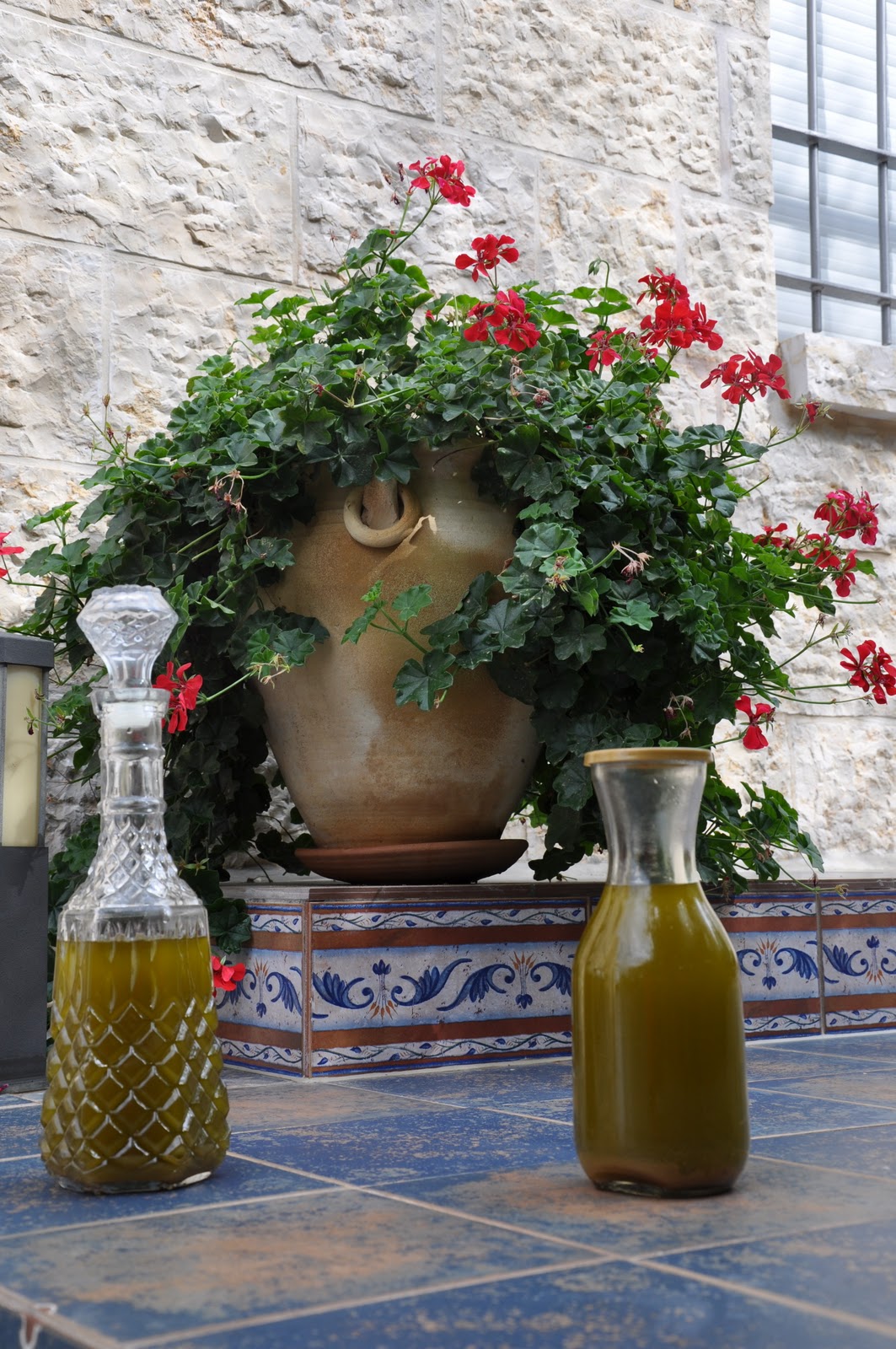
delicious fresh olive oil - YUM!
   Have you ever dipped bread in olive oil and then eaten the bread, trying not to drip the olive oil on your clothes?  I LOVE olive oil, and at Duha's and Sami's I had some that was very very fresh and it was DElicious.  Oh my, if you like olive oil, you would have LOVED this oil.  Duha got it from farmers who grow the olives and press them locally.
   Duha had two different olive oils, one from a village outside Jerusalem and the other from Beir Zeit ("zeit" means olive) which is near Ramallah and the home of the university where Duha and Sami met.  I tried both, dipping fresh Arabic bread in them.  Oh, my, they were soooooooooooo good.  They were cloudy because they were so fresh and, after all, they're made of pressed olives, just like cider is made from pressed apples.  I would have been happy with a meal of fresh bread, those olive oils and some fruit or a salad.
   When I left Duha's and Sami's late that afternoon, they said: "Remember, now you have two homes in Palestine, Khitam's and our house.  You are always welcome here."  That's also what Toujan's mother said when Khitam and I left their home.  The hospitality here is very warm.  It's also a good idea to remember to be very hungry if you are visiting a Palestinian home because they won't let you go without feeding you,  and the food is awfully good!
   Today I go to Acca ("Acre" on a map, north of Tel Aviv on the coast of Israel) to Khitam's family home.  I'll be there with Khitam and her friend and family until Saturday and then come back here.  If they have wireless there, I'll write you another couple of blogs.  The next one will be about Khitam working with kindergarten teachers.
   Drink lots of water and read a book.  Oh, and have fun!  Grampa Al

Monday, November 1, 2010

Toujan, Duha and Sami and Khalil

Toujon, second from left, & family
 Khitam brought Toujan to Maine six years ago with Amneh, two Palestinian girls from old Jerusalem.  She was fourteen then.  That summer, I spoke with her mother on the phone and she said: "Al, when you are coming to visit us?"  I finally got there.
   Sunday, Khitam and I met Toujan in the old city, where, like Mohammed and Rafat, she lives, and she took us to her home.  Like Rafat's, it's hidden away.  Once inside, we were unaware of the hustle and bustle in the narrow byways outside.  She lives with her mother, a kindergarten teacher, her father, three brothers, an older sister and the sister's baby and husband.  A lot of people in a small apartment, but they make it work.  They're a happy close-knit bunch and were very hospitable to Khitam and me.  We were with them for three hours, which included a meal, of course: lebneh, two kinds of bread, mane'eesh (sort of an Arabic pizza with olive oil and zatar - thyme), tomatoes and cucumbers, hummus, baba ghanouj, homemade jam, olives, pickled veggies and more.  Afterwards, coffee, a few gifts, and we left.  They are a warm welcoming family - "Al, now you have two homes in Palestine: Khitam's and our house."  You want to be hungry whenever you visit a home here.
Sami & Duha
   Sunday I went to Ramallah to visit Duha and Sami.  Duha is a kindergarten teacher at the Friends School in Ramallah.  I met her when I did workshops there in 1998 and she and her two girls came to Maine that summer and stayed with me while Duha and Rana, then a seventh grader, participated in our theater summer camp.  Dana, the younger daughter, was too young so she came every day with Duha. 
Rena & some old guy
   They live in a beautiful home on the edge of Ramallah.  "I don't go out," Duha says.  "I take a taxi to school and after I come home."  She loves to cook, garden, teach kindergarten, work with the community and enjoy her family.  We talked and talked while she prepared "lunch," a large dinner anywhere else.  When Sami came home, we talked more and had a wonderful meal.  Even Rana, vastly changed from that seventh grader I knew, stopped by to say hello and then hurried back to work.
   I remember how Rana often wore a Chicago Bulls t-shirt and loved basketball.  She told me she still does!  Our daughter Wendy said: "Dad, if you want people to know the Palestinians and their story, the best thing you can do is have Rana stay here for a year, go to the junior high, wear her Bulls t-shirt and play basketball.  Then people will see that Palestinians are like us."  
   Duha and I talked long about Palestine and their life while she cooked.  She said a lot of wise things.  "We need open child raising, not closed.  And we need to pay attention to the children, listen to them and encourage them in school.  Too many teachers say the children are lazy, don't care, don't pay attention."  We agreed that a teacher's primary objective is the children's success, not their failure, proof that they're not trying or not smart.  She also talked about the way communities used to cooperate to get things done and how that tendency is disappearing, so she is working to bring back that spirit.  She wanted a public recreation space in the middle of town so she got the municipality to donate a space and then she began working with the community to raise money for the playground.  Now there is a marathon walk every year and the walkers get sponsors and donate the money to the new space, which is in the works.  She has also helped organize a voluntary green movement in the elementary schools.
   I have to take a moment, here, to write about olive oil.  Duha uses fresh ingredients: spices she grows or finds, vegetables she grows or from the farmer, and olives and olive oil she purchases as soon after their preparation as possible.  I tasted two fresh olive oils and each was DElicious, a flavor unlike any I  
fresh olive oil, hmmm...
have tasted before!  The oils are still a little cloudy because they are so fresh.  One is from a village near Jerusalem, the other from Beir Zeit ("zeit" means olive oil), near Ramallah.  They were rich and peppery.  I could have had nothing but fresh Arabic bread and olive oil, a glass or two of wine and maybe a piece of fruit and I would have been very well served!
   Sami came home while Duha was showing me her garden.  I had met him earlier on this visit when Khitam and I joined them and two others for dinner in Ramallah.  Sami had not come to the States with Duha and his daughters because he was in Israeli prison at the time.  He is a warm, bright and articulate, very interesting man, and I feel lucky to be getting to know him at last.  He is also a Palestinian patriot, and in the past, a non violent activist for Palestinian independence.  He was imprisoned by the Israelis several times because of his activities for an independent Palestine, until after the first Intifada, which ended in 1991 with the Madrid accords.  He told me a story I'll pass on.
   When the Palestinians who were in the Israeli prison with Sami heard about Madrid, they got very excited because they thought - they hoped - it meant they would be out of prison in a matter of days.  One day the commander of the guards called Sami over.  "Sami, why are they so excited?" he asked.  He spoke with Sami because Sami could translate for him and the Palestinians.  "Because they think they're going to get out soon and be free."  "Sami," said the commander, "I'll tell you a story."  This is the story.
   One night, a mother went to bed with her baby next to her.  In the middle of the night, the baby started to cry.  The mother endured it for a while, then moved to the other side of the bed.  The baby continued to cry and the mother endured it for a while, then pulled the covers over her head.  The baby continued to cry and the mother endured it for a while, then put a pillow over her head and then the covers.  The baby continued to cry and the mother couldn't get back to sleep so finally she got up and fed the baby.  "Sami," the guard said, "we are the mother and you are the baby.  We're not going to give you your freedom so easily, not until you make us give it to you."
   "Al, that's when I knew we were not strong enough.  A freedom fighter has to take prison as a normal part of fighting for freedom.  Of course you'll be put in prison.  You have to accept that.  When I went into prison, I went with a smile on my face.  When I came out of prison, I had the same smile on my face.  And I am never violent, never!  I was not violent in the streets and I was not violent in prison.  I don't want to hurt anybody.  I want to work for freedom for my country.  But when I got out of prison, Duha and I talked for three months, and I decided to leave the movement and start working.  And you know, Al, I know now I made the right decision."
   When I left Duha and Sami late that afternoon to have a coffee in Ramallah with Rafat and Ahmad and their friend Ehab (I thought it was spelled Ahad because it is pronounced that way), I told Duha and Sami what a good day it had been for me to spend with them and they said: "Remember Al, you have two homes now in Palestine: Khitam's and ours.  You are always welcome."
   After coffee and an Arabic sweet with the boys in Ramallah, they drove me back to Khitam's in Arram.  When we got to the check point, traffic was backed up and hardly moving.  That, of course, is when I realized I needed a bathroom.  As we inched forward, I was reminded yet again how "inconvenient" the check points are, and my Palestinian friends pass them every day, going and coming.