With apologies for my cyber-ignorance, I'll post photos as soon as I can, once back in Maine on May Day. I won't bother with the reasons, but know it is I, not my laptop, that is the stumbling block and stumbler. There, I feel better already.
Monday, Khitam and I headed for Azareya, where Nasser's new school is. Not far from Jerusalem, Azareya is a busy town with a middle school that has kids from a Bedouin camp, a refugee camp, from the town itself and from neighboring villages. The students are a very mixed population of twelve to fifteen year-olds who do not normally socialize; to put it another way, a good setting for a Palestinian production of West Side Story...East Side Story.
Here's some essential background. Nasser had been the sole counselor for several years at a middle school in Adahya, near heard my friend Khitam's home. The last two years when I've been here, I've done some work with Nasser at that school. Last year, the Palestinian Ministry of Education announced this year's postings and Nasser discovered he was being moved to another school. The community around the school in Adahya rallied to keep him here. Nasser urged the Ministry to let him continue his work in Adahya where he had developed programs that were successful keeping kids in school, committed to doing their work and not causing trouble. He was working with students from difficult surroundings: single parent homes because the father had been killed, was in prison, or had given up and left the family; families with drug and alcohol abuse; families with domestic violence. The answer was no and Nasser was moved to Azareya.
New school, new problems, new community: Nasser went to work. The principal, Mohamed, was new, a former chemistry teacher in his first principal's job. His predecessor had been there a long time and had had no interest in change. Mohamed recognized he had a leader in Nasser, one who could make a real difference in the school if he supported him He also needed him; Nasser's experience would be very important to this new principal. Soon Nasser had enlisted a few teachers to join his merry band of reformers. "I thought it would take me three years to make progress here, but now, seven months into the school year, we already see change," he told me. He was right.
Palestinian schools do not receive the support Israeli schools get. It's complicated. Some schools for Palestinians are under the jurisdiction of the Israeli Ministry of Education, and some are not. Some receive funding from Palestinian NGOs; some receive funding from European, or American NGOs. Some receive extra funding from the Ministry for special projects but not without jumping through several bureaucratic hoops. In general, Palestinian schools are underfunded.
Nasser does not receive extra pay for extra work. As far as I could tell this week, he is the last educator to leave the school, not because he has nowhere to go. He is married and has five children, including the family's first girl, born while he was in Maine last summer. Nasser is the last to leave and probably often the first to arrive because he has a lot he wants to do. Tuesday, parents prepared a small banquet for us - Nasser, Khitam, Nabil (a science teacher who is an early convert and in some ways Nasser's right hand man), five BA and MA candidates at Jerusalem University who are doing on the job training at the school and have become "Nasser's Army," (more on them in another blog), and me. Nasser began telling me about his dream and how he has started on it.
"Do you remember last year when I told you the dream of having a space where teachers can do workshops. learn new methods, meet to plan new work? We talked about finding some money to rent a space." At the time, I thought the dream a good but unlikely one. Finding money for such a project is difficult anywhere and especially difficult here. Then he said: "We have a space! One of the parents is donating it to us. He has a building near here."
I was amazed and delighted, almost as excited as Nasser was. He reminded me: "Remember I told you if you have a dream and believe in it, you will find it." If you build it they will come. So we began to discuss what can happen there. "I want to be partners with The Theater Project and The Telling Room. We will be separate and far away from the Ministry of Education!" Bureaucracy be damned. He wants to encourage child centered learning which is not the tradition in Arab education, though it is practiced in some Arab schools. He wants people to do workshops in the arts, in new ways to use technology, in teaching techniques and styles.
This man is ahead of his time here and he is timely. He is also tireless and I think eternally hopeful. He doesn't approve of the alternative. When he returned from his two weeks in Maine last summer, he flew into Amman, Jordan and then took a bus to the Jordan River, the border with the Israeli occupied West Bank. Jordanian Security quizzed him on where he'd been, why he'd been there, what he had done. He told them he had been in the States visiting a theater and looking for non- violent alternatives for raising Palestinian children to become good Palestinian citizens.
When he crossed the Allenby Bridge onto the West Bank, Israeli Security asked him the same questions. He said: "You can put your gun down. I'm not a violent person. I had experience with violence when I was young and now I want non-violent ways to raise our children." The Israeli said he agreed. Nasser said: "Good. We don't have to be enemies, but I can never agree to your occupation." This is the gist of what he told me; my faulty memory allows me only approximate quotes.
Then Nasser went home to rejoin his family and meet his new daughter.
Welcome to Palestine.
Thursday, April 21, 2016

Wednesday, April 20, 2016
The Dead Sea, The Live Land
Sunday is a work day in Palestine. The weekend comprises Friday and Saturday, except for businesses that also recognize Sunday as a religious holiday. I was going to teach at a school in Adahya not far from Khitam's abode, but Sunday morning we learned the students would be released early in support of Palestinian prisoners. "Why do the students have this time out of school?" Khitam asked. "There are already more than enough days when school is not in session, and they need the time in school." She was passionate about this. She questioned whether most students recognized the day as special: "This should be adults' responsibility, not the students. They need the time to study!" This even as she has many questions about the values and techniques in many Palestinian classrooms.
So our day was knocked off center. Khitam does not sit around and brood. "Do you want to go to The Dead Sea?" I said, sure, if she did. She went to the kitchen, packed a picnic and soon we were off, including Chelsea who had spent the night on Khitam's couch.
A drive to The Dead Sea is a drive down, down, down. One of the lowest places on earth, it is far below sea level. As you descend, the air gets drier and warmer, and there is less and less sign of anything growing. It isn't bleak; it's just a different landscape; like landing on a different planet. When we arrived on the floor of the valley, we proceeded toward The Dead Sea, passing a deserted Jordanian Army base en route. The Jordanians lost the fort and everything else in the 1967 June War.
We pulled into a parking lot above The Dead Sea, changed into our swim suits and climbed down many many steps to the water's edge. The land is gritty, pebbly, hard on bare feet; we all had sandals. We parked ourselves under an umbrella and unpacked lunch on a picnic table, then went into the water. Actually, it's more like going onto the water. The sea is so salty that you bob to the surface and it's a struggle to completely submerge yourself, and doing that is undesirable. If you get any water in your eyes, the stinging is intense, and the only way to wash them out is to bob back to the shore, climb out and get under one of the fresh water showers for relief. You clamber over a rocky seafloor, your balance a little cockeyed from the buoyancy of the sea, squinting out of one eye, hoping no one is watching your clumsy progress toward the relief of fresh water.
I remember the first time I swam there, in 1962, when we went by motor scooter from Beirut to Jerusalem, Bethlehem and The Dead Sea. It was easy then and so it continued until the war in 1967. Now you wonder about checkpoints and roadblocks if you're Palestinian and starting on a little trip, whether it's work or pleasure. From time to time, Khitam has to cancel a teaching project because of road blocks that can delay her passage for hours. Monday night, after she had taught for three or four hours in Jerusalem, it took her two hours to get home because of check points and an accident on the way. I had gotten home around 5:30 and expect her around 7:00. I was beginning to worry about her when I heard the door open and her voice: "Hi, babe." She had called the neighbor, Abu Abdullah, to ask him to come over and tell me she was on the way if she hadn't shown up in half an hour.
Welcome to Palestine.
Back to the afternoon, we had a picnic after floating on the sea for a while, then sat under and outside of the table umbrella for a couple of hours. Khitam and Chelsea went in for another float, then we headed home, an hour's drive. It had been a relaxing, hot and salty day, and Khitam and I caught up some more that evening. Monday, we both had teaching gigs, and it looked like they were going to happen, though you never know, here. It's such an austerely beautiful place, this land of eight month summers, and it is so tortured by the area's politics. And still, the people welcome you and say you must come to their home for a meal. You must!
Welcome to Palestine. .
So our day was knocked off center. Khitam does not sit around and brood. "Do you want to go to The Dead Sea?" I said, sure, if she did. She went to the kitchen, packed a picnic and soon we were off, including Chelsea who had spent the night on Khitam's couch.
A drive to The Dead Sea is a drive down, down, down. One of the lowest places on earth, it is far below sea level. As you descend, the air gets drier and warmer, and there is less and less sign of anything growing. It isn't bleak; it's just a different landscape; like landing on a different planet. When we arrived on the floor of the valley, we proceeded toward The Dead Sea, passing a deserted Jordanian Army base en route. The Jordanians lost the fort and everything else in the 1967 June War.
We pulled into a parking lot above The Dead Sea, changed into our swim suits and climbed down many many steps to the water's edge. The land is gritty, pebbly, hard on bare feet; we all had sandals. We parked ourselves under an umbrella and unpacked lunch on a picnic table, then went into the water. Actually, it's more like going onto the water. The sea is so salty that you bob to the surface and it's a struggle to completely submerge yourself, and doing that is undesirable. If you get any water in your eyes, the stinging is intense, and the only way to wash them out is to bob back to the shore, climb out and get under one of the fresh water showers for relief. You clamber over a rocky seafloor, your balance a little cockeyed from the buoyancy of the sea, squinting out of one eye, hoping no one is watching your clumsy progress toward the relief of fresh water.
I remember the first time I swam there, in 1962, when we went by motor scooter from Beirut to Jerusalem, Bethlehem and The Dead Sea. It was easy then and so it continued until the war in 1967. Now you wonder about checkpoints and roadblocks if you're Palestinian and starting on a little trip, whether it's work or pleasure. From time to time, Khitam has to cancel a teaching project because of road blocks that can delay her passage for hours. Monday night, after she had taught for three or four hours in Jerusalem, it took her two hours to get home because of check points and an accident on the way. I had gotten home around 5:30 and expect her around 7:00. I was beginning to worry about her when I heard the door open and her voice: "Hi, babe." She had called the neighbor, Abu Abdullah, to ask him to come over and tell me she was on the way if she hadn't shown up in half an hour.
Welcome to Palestine.
Back to the afternoon, we had a picnic after floating on the sea for a while, then sat under and outside of the table umbrella for a couple of hours. Khitam and Chelsea went in for another float, then we headed home, an hour's drive. It had been a relaxing, hot and salty day, and Khitam and I caught up some more that evening. Monday, we both had teaching gigs, and it looked like they were going to happen, though you never know, here. It's such an austerely beautiful place, this land of eight month summers, and it is so tortured by the area's politics. And still, the people welcome you and say you must come to their home for a meal. You must!
Welcome to Palestine. .
Sunday, April 17, 2016
Welcome to Palestine
My Turkish Air flight from Istanbul landed at Ben Gurion Airport in Tel Aviv at 8:30, Friday night. It was dark here, the plane was full of passengers returning home to Israeli and Palestinian homes and people visiting. When we got to passport control, there were no lines at the booths designated for visitors. A year ago, when I came, the lines were backed up to the entrance to the hall. I remember watching a family of four, the two kids about six and eight, both tired, and the mom and dad patiently soothing the kids, telling them, "It won't be long now." I had let them go ahead of me when we arrived in line together. A week and a half later, on a visit to friends of my friend Khitam in Beir Zeit, a university town not far from Jerusalem, I met them. They had come to visit Khitam's friends, all of whom met in Cambridge, while studying in the States.
Welcome to Palestine.
"What is the reason for your visit? Where will you be staying? Have you been here before? Many times? Why?" And then through the doors into the hall where friends and relatives wait, and there was Khitam, smiling as usual, looking very comfortable in skirt and sleeveless blouse. I had on a long sleeve shirt and a jacket from LL Bean, easier to wear than to carry.
We drove to Adahya, a town on the wrong side of the wall and where Khitam lives. Adahya used to be a part of greater Jerusalem, but the wall brought separation. She parked, half on the street, half on what's left of the sidewalk in front of her house; nor was her car the only one on the sidewalk. "Have more people moved here? There are a lot more cars than I remember." She said several people had moved in. They like the area because it's relatively quiet and there are plenty of apartments in buildings that went up before the wall when Palestinians were returning to their homeland and also moving to the city from villages outside.
We ate some chicken and rice with local spices and those we know well. And there were green and black olives from olive tress on the family land, and fresh khubs Arabi - Arabic bread from a nearby bakery, and olive oil from the family olives and zatar, a mix of sumac, thyme and a few spices for the bread after it's dipped in olive oil, and salad and a bottle of wine from the monastery in Latroun (more on Latroun later). A light supper while we talked until midnight (5:00 PM in Maine, but my inner clock, which is generally unreliable, had given up trying to figure out the time. To bed until 4:00, when I was briefly wide awake to hear the muezzins in the neighborhood call the faithful out to the day's first prayer, then back to sleep until 8:30.
Welcome to Palestine.
Late yesterday morning, after Arabic coffee and more talk, Khitam packed a picnic and we headed out to drive to Latroun, west of Jerusalem. We drove out of Adahya, taking a circuitous route to Jerusalem to avoid a clogged Qalandia checkpoint by going through the usually vacant Jeba'
checkpoint. Traffic was backed up hundreds of yards from Jeba' and there was no movement. Cars were turning around and driving back on the side of the road. Khitam did the same: "We'll try Qalandia." We got close to Qalandia and ran into the same stuck long line of traffic. We waited, then she bucked traffic again, turned around while cars jostled and honked, and drove back toward Jeba'. The line hadn't moved.
We waited in line, barely moving, for at least an hour and a half - tick-tock, tick-tock... People got out of their cars and trucks, walked toward the front of the line to see if there was news of...of what? A reason for the roadblock? A time it would be removed? Then, all of a sudden, people started running back up the line toward their cars and trucks. Khitam and I got back in her car. Engines started; it was a poor man's Indianapolis 500 revving up. Traffic started moving. Within minutes, we got to the checkpoint where the roadblock had been. No one was there. It had disappeared.
Welcome to Palestine.
So we drove to Jerusalem to pick up Chelsea, who is shadowing Khitam while pursuing her MA in Arts Therapy, then on to Latroun, site of a Trappist monastery settled among olive trees. The monks make fine wine and honey and sell it in a shop at the monastery. There is parking nearby and Saturday, there was a crafts fair in the parking lot. Friends of Khitam were selling beautifully embroidered Palestinian pillow covers and handbags of various sizes. It was hot. Khitam grilled some marinated chicken and beef to go with the salads she had brought, along with the olives, olive oil, salty white cheese that I love, khubs Arabi and zatar. We sat at a picnic table and enjoyed our relaxed meal. Afterwards, Khitam got her narghile going, we talked, and eventually headed back to Jerusalem. We left Chelsea at her hotel, then Khitam said: "One more little stop before we go home." She pulled up to a small Arabic sweets shot, ordered two Kanafe bil Jibneh, a delicious Arabic sweet of creamy cheese, a shredded wheat sort of topping and a sweet syrup. We got back in the car and Khitam said, "If this wall weren't here, we'd be home in three minutes. It's right there," and she pointed to the wall. Twenty minutes later, we were home.
Welcome to Palestine.
Welcome to Palestine.
"What is the reason for your visit? Where will you be staying? Have you been here before? Many times? Why?" And then through the doors into the hall where friends and relatives wait, and there was Khitam, smiling as usual, looking very comfortable in skirt and sleeveless blouse. I had on a long sleeve shirt and a jacket from LL Bean, easier to wear than to carry.
We drove to Adahya, a town on the wrong side of the wall and where Khitam lives. Adahya used to be a part of greater Jerusalem, but the wall brought separation. She parked, half on the street, half on what's left of the sidewalk in front of her house; nor was her car the only one on the sidewalk. "Have more people moved here? There are a lot more cars than I remember." She said several people had moved in. They like the area because it's relatively quiet and there are plenty of apartments in buildings that went up before the wall when Palestinians were returning to their homeland and also moving to the city from villages outside.
We ate some chicken and rice with local spices and those we know well. And there were green and black olives from olive tress on the family land, and fresh khubs Arabi - Arabic bread from a nearby bakery, and olive oil from the family olives and zatar, a mix of sumac, thyme and a few spices for the bread after it's dipped in olive oil, and salad and a bottle of wine from the monastery in Latroun (more on Latroun later). A light supper while we talked until midnight (5:00 PM in Maine, but my inner clock, which is generally unreliable, had given up trying to figure out the time. To bed until 4:00, when I was briefly wide awake to hear the muezzins in the neighborhood call the faithful out to the day's first prayer, then back to sleep until 8:30.
Welcome to Palestine.
Late yesterday morning, after Arabic coffee and more talk, Khitam packed a picnic and we headed out to drive to Latroun, west of Jerusalem. We drove out of Adahya, taking a circuitous route to Jerusalem to avoid a clogged Qalandia checkpoint by going through the usually vacant Jeba'
checkpoint. Traffic was backed up hundreds of yards from Jeba' and there was no movement. Cars were turning around and driving back on the side of the road. Khitam did the same: "We'll try Qalandia." We got close to Qalandia and ran into the same stuck long line of traffic. We waited, then she bucked traffic again, turned around while cars jostled and honked, and drove back toward Jeba'. The line hadn't moved.
We waited in line, barely moving, for at least an hour and a half - tick-tock, tick-tock... People got out of their cars and trucks, walked toward the front of the line to see if there was news of...of what? A reason for the roadblock? A time it would be removed? Then, all of a sudden, people started running back up the line toward their cars and trucks. Khitam and I got back in her car. Engines started; it was a poor man's Indianapolis 500 revving up. Traffic started moving. Within minutes, we got to the checkpoint where the roadblock had been. No one was there. It had disappeared.
Welcome to Palestine.
So we drove to Jerusalem to pick up Chelsea, who is shadowing Khitam while pursuing her MA in Arts Therapy, then on to Latroun, site of a Trappist monastery settled among olive trees. The monks make fine wine and honey and sell it in a shop at the monastery. There is parking nearby and Saturday, there was a crafts fair in the parking lot. Friends of Khitam were selling beautifully embroidered Palestinian pillow covers and handbags of various sizes. It was hot. Khitam grilled some marinated chicken and beef to go with the salads she had brought, along with the olives, olive oil, salty white cheese that I love, khubs Arabi and zatar. We sat at a picnic table and enjoyed our relaxed meal. Afterwards, Khitam got her narghile going, we talked, and eventually headed back to Jerusalem. We left Chelsea at her hotel, then Khitam said: "One more little stop before we go home." She pulled up to a small Arabic sweets shot, ordered two Kanafe bil Jibneh, a delicious Arabic sweet of creamy cheese, a shredded wheat sort of topping and a sweet syrup. We got back in the car and Khitam said, "If this wall weren't here, we'd be home in three minutes. It's right there," and she pointed to the wall. Twenty minutes later, we were home.
Welcome to Palestine.
Tuesday, April 12, 2016
Going again...
I'm flying out of Logan, Thursday night, for Tel Aviv. I'll be spending two weeks in Palestine, teaching workshops and visiting friends. I plan to blog again, announcing the blogs on Facebook, so tune in if you're interested.
Tuesday, May 12, 2015
A potpourri...
 |
| Khitam |
 |
| Palestinian village |
 |
| On the bus |
I met Khitam's friend Antoine on the street in Acre, when we were visiting Khitam's family. He speaks fluent English and is a Palestinian Christian. When he was in high school, he met and fell in love with Taghreed, a young Muslim, and she fell in love with him. Their love blossomed and they eventually decided to marry. Antoine's father was furious and kicked him out of the house. Still he and Taghreed were determined to get married. When Khitam's mother, a devout Muslim and a widow then, heard about Antoine and his father, she decided to step in. There is a tradition before a wedding of the groom's friends giving him a bath, a dose of the local version of Old Spice and generally making sure he was all spiffed up for his wedding. Since that was no longer possible at Antoine's house, Khitam's mother held the ceremonial bath at her house, making sure Antoine knew he had a second home there.
 |
| Budding artists waiting to make art on the bus |
I attended two concerts with Khitam and Cotton, the second the night before I left, which left me sleep deprived but exhilarated when I got on the plane in Tel Aviv. The musicians were The Trio Jubran, Palestinian brothers who play the oud and are accompanied by Youseff Hbeisch, a remarkable percussionist I had heard at an earlier concert with the Oriental Ensemble. The Trio Jubran tours extensively and no longer live in Palestine. They played three concerts in two days while there, one in East Jerusalem and two in Ramallah where we heard them. They had come from Oman and were headed to Russia with Palestine sandwiched in between.
 |
| Jihad and Rima'a |
 |
| Warm up in a teachers workshop |
 |
| Teachers at a workshop in East Jerusalem |
 |
| Take the #@# picture! I'm in a hurry. |
 |
| Just a light evening snack in Zada's kitchen |
 |
| The next generations in Khitam's extended family |
Saturday, May 2, 2015
Zada, Tel Dan Nature Reserve and the Golan
I'm back in Adahya, where Khitam and Ahmad live, after two days and nights in and around Acre where her five sisters and four out of her five brothers live. Which reminds me to correct an earlier blog: three of Khitam's sisters are widows, not all five of them and all five are hajis. women who've been to Mecca. This will be my last blog from Palestine. It's Saturday evening and I leave early Monday morning. I hope to write one more, reflecting on my two and a half weeks here, after I return to Maine.
Wednesday and Thursday nights we spent with Zada, the youngest of Khitam's five older sisters. She is closest to Zada, who was a second mother after their mother died when Khitam was seventeen. Zada is the toughest of the sisters and the most outgoing. I told Khitam Zada was very welcoming and strong and that I doubted I would want to get on her bad side. "Oh no, you don't want to get Zada angry at you!" she said.
We arrived around 5:30, Wednesday, after our delicious and very filling "lunch" at Naseba's. I assumed we wouldn't eat again - silly me! Within an hour, the house was packed with family. Inas arrived; he is one of Zada's sons, married to Hinadi and they have five children. They have a house near his Zada's but live during the week in Haifa because he and Hinadi both work there. Nasri and his wife Zuzu were also there with their two young daughters; he is Inas' brother and he and his family live between Zada and Inas. Zada's other son lives upstairs with his family. Zada's daughter Nisreen was also there and a few others I don't know. Everyone ate: there's was a mezza with plenty of food for everyone. Family lingered and talked, watched TV, let the children run the show until they were worn out and in someone's lap.
Villages like Naher, where Zada and most of her family live, seem randomly assembled with neither rhyme nor reason; however, there is reason and it's based on the family. Often, villages had large plots of land owned by a family, maybe the grandfather of those who live there now. After a son found work and married, he would likely build a house for his own family on his father's land. The same would happen with the next son and the next if there were more. Daughters would move to a house their husband would build on his family's land. And so the traditional village grew, not from a town plan but from family plans. As a result, village and town roads are often challenging for cars going in opposite directions and horns are essential before rounding the corner of a building that abuts the street.
Thursday, Khitam, Ahmad and I headed for the Golan, that area that sticks into Syria like a peninsula and was once Syrian and Palestinian but has been occupied by Israel since the 1967 war. It's a beautiful drive. The countryside is dotted with Palestinian villages and olive grooves. There are several Palestinian villages where Muslims, Christians and Druze mix easily. We hiked for an hour and a half in the Tel Dan Nature Reserve in the Golan, a natural park maintained by Israel's Parks Authority. It is lovely, with the Dan River rushing full of melted snow from Mt. Hermon. In this part of the world, water is very important, as it is becoming in more and more of the world. There were several groups of Palestinian students in the park with their teachers and leaders. These are Palestinian residents of Israel who comprise 20% of Israel's population.
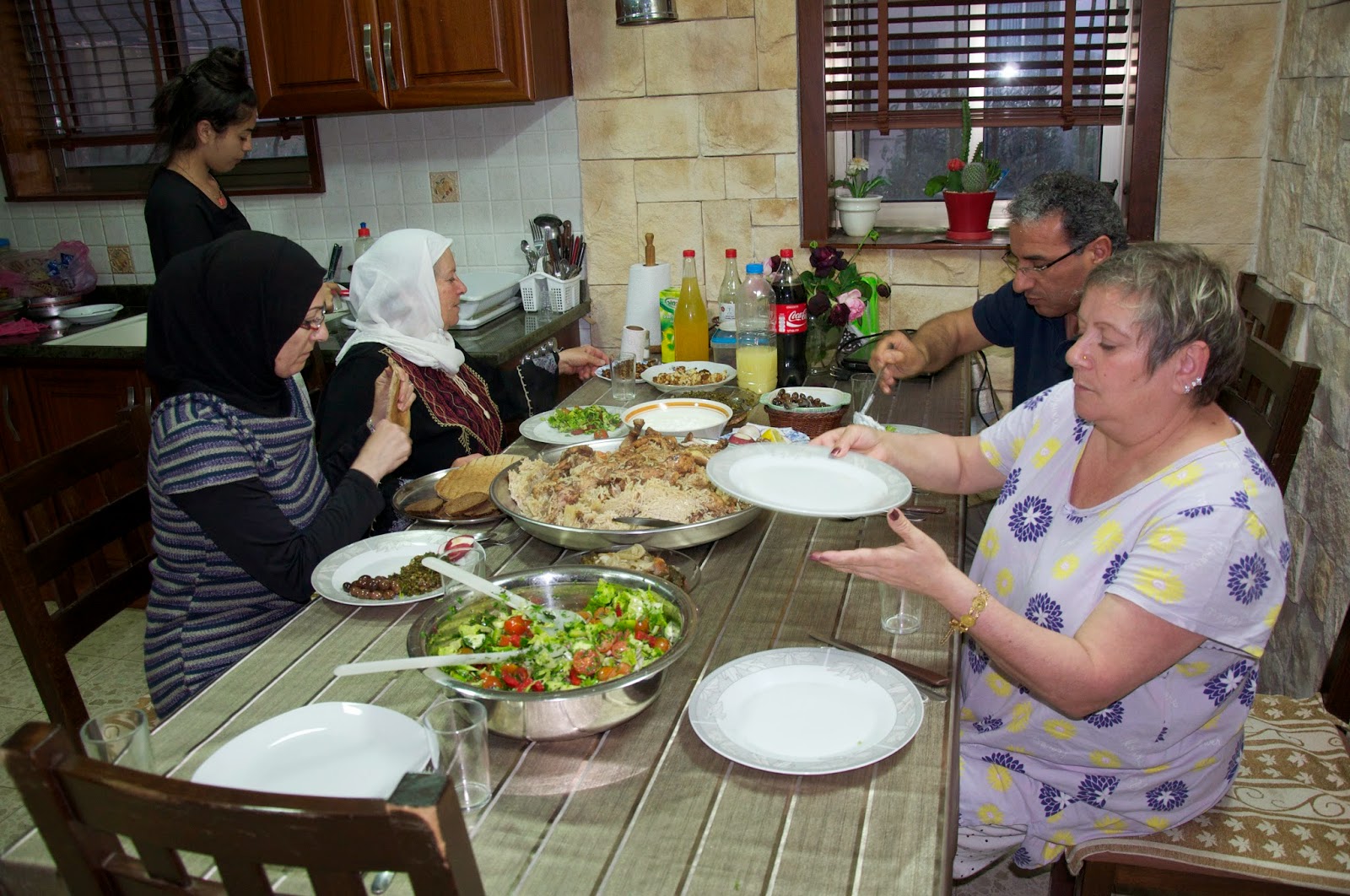
When we got back to Naher, Zada was already hard at work on dinner. It was ready an hour and a half later: on a tray that was at least two and a half feet in diameter maklouba was piled, a delicious mix of rice, carrots, onions and chicken all cooked together. There was enough for a week unless you were at Zada's house. It would all be gone in a couple of days with sons and daughters and grandchildren and nephews and nieces coming by to eat. Zada also put on the table a large salad, roasted cauliflower, stuffed grape leaves, yoghurt, olives, bread and probably more I can't remember. As we ate and after, family members stopped by, had a little or a lot to eat, and moved outside or to the living room or porch to talk, the kids to play. Tonight there will be more family to sit down and eat; tomorrow there will be little maklouba left, if any.
On our way home from Naher yesterday, we stopped in Rama, one of those mixed villages I just mentioned, to visit with Habib and Minerva Daoud, a Palestinian couple who have run a small restaurant there for twenty years. We had fresh lemonade, Arabic coffee and a light creamy pudding that Habib had made that morning. He is the cook in their restaurant, offering "traditional Palestinian cooking with a contemporary twist." He asked Ahmad about his work and Ahmad told him he had just found something in the Acre area but his real love is wine - he lived and worked in France for twenty-three years - and he'd like to find wine-related work. His goal is to be a sommelier. Habib called an Israeli wine-maker in the area, a friend of his, told him about Ahmad's interest and set up a meeting for the two of them. He also offered to host wine-tasting dinners at his restaurant. It's all who you know! We left without paying; Habib and Minerva wouldn't hear of it.
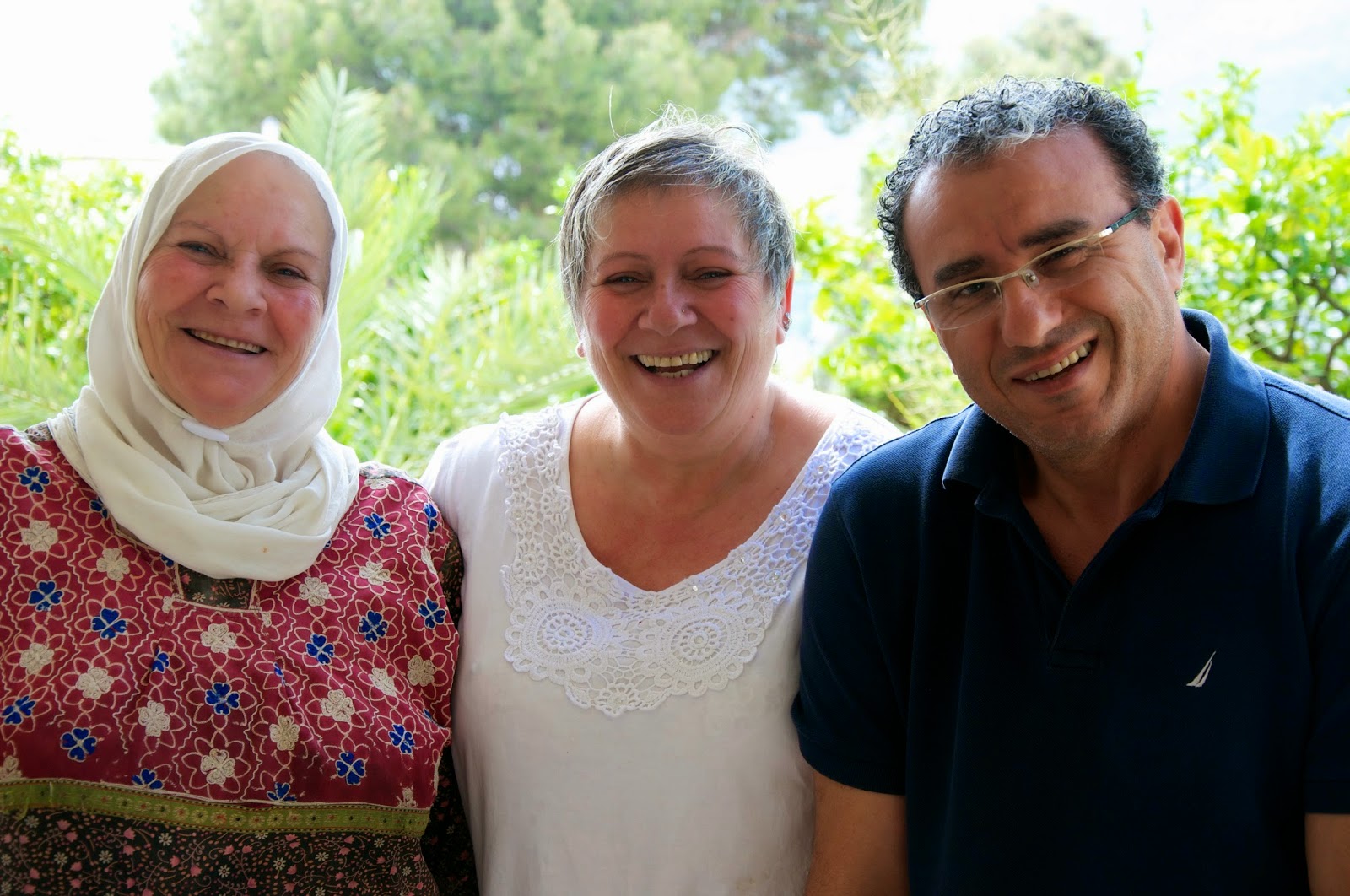 |
| Zada, Khitam and Ahmad |
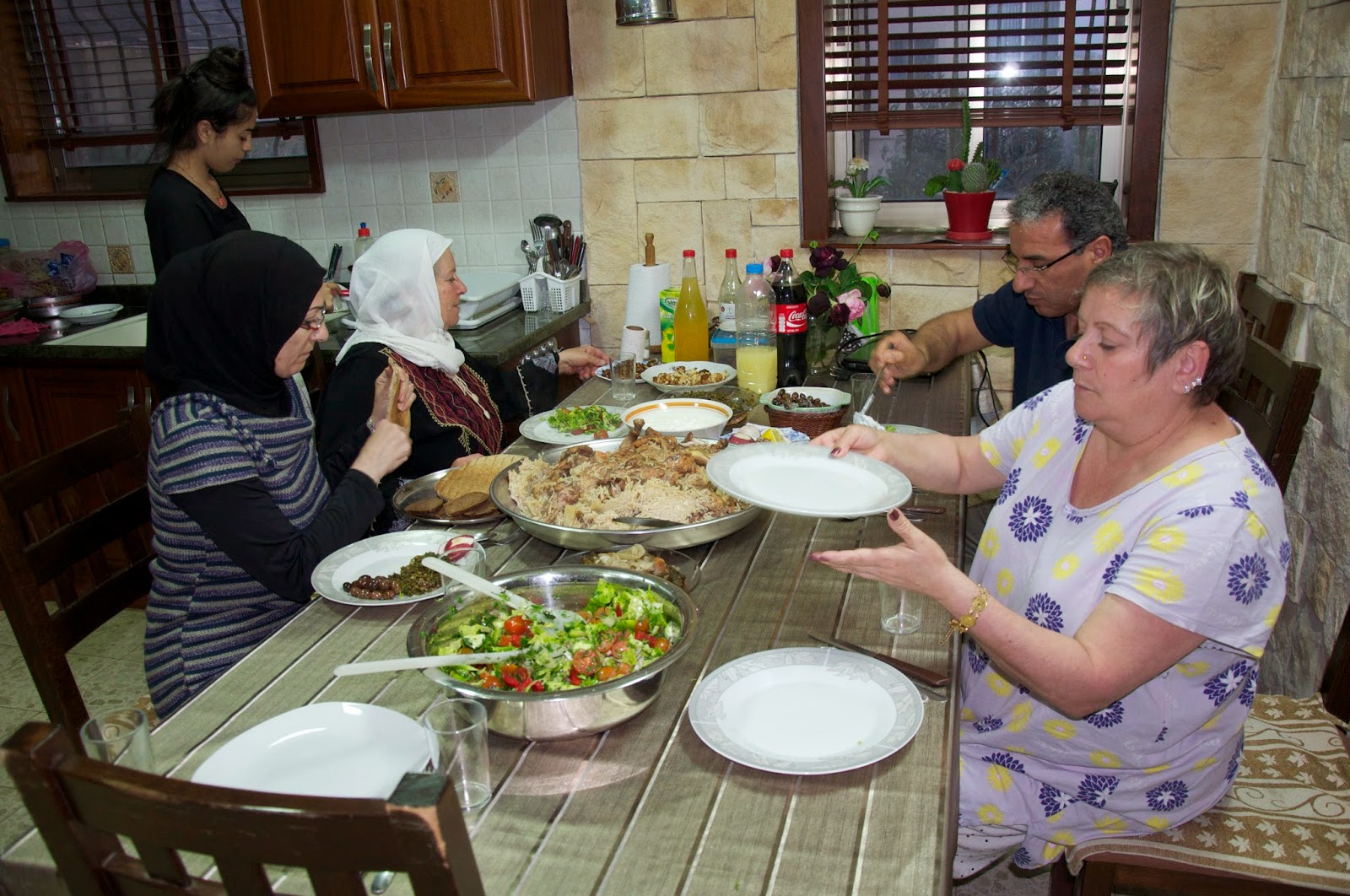 |
| Nisreen, Zada, Ahmad and Khitam and a "light supper" |
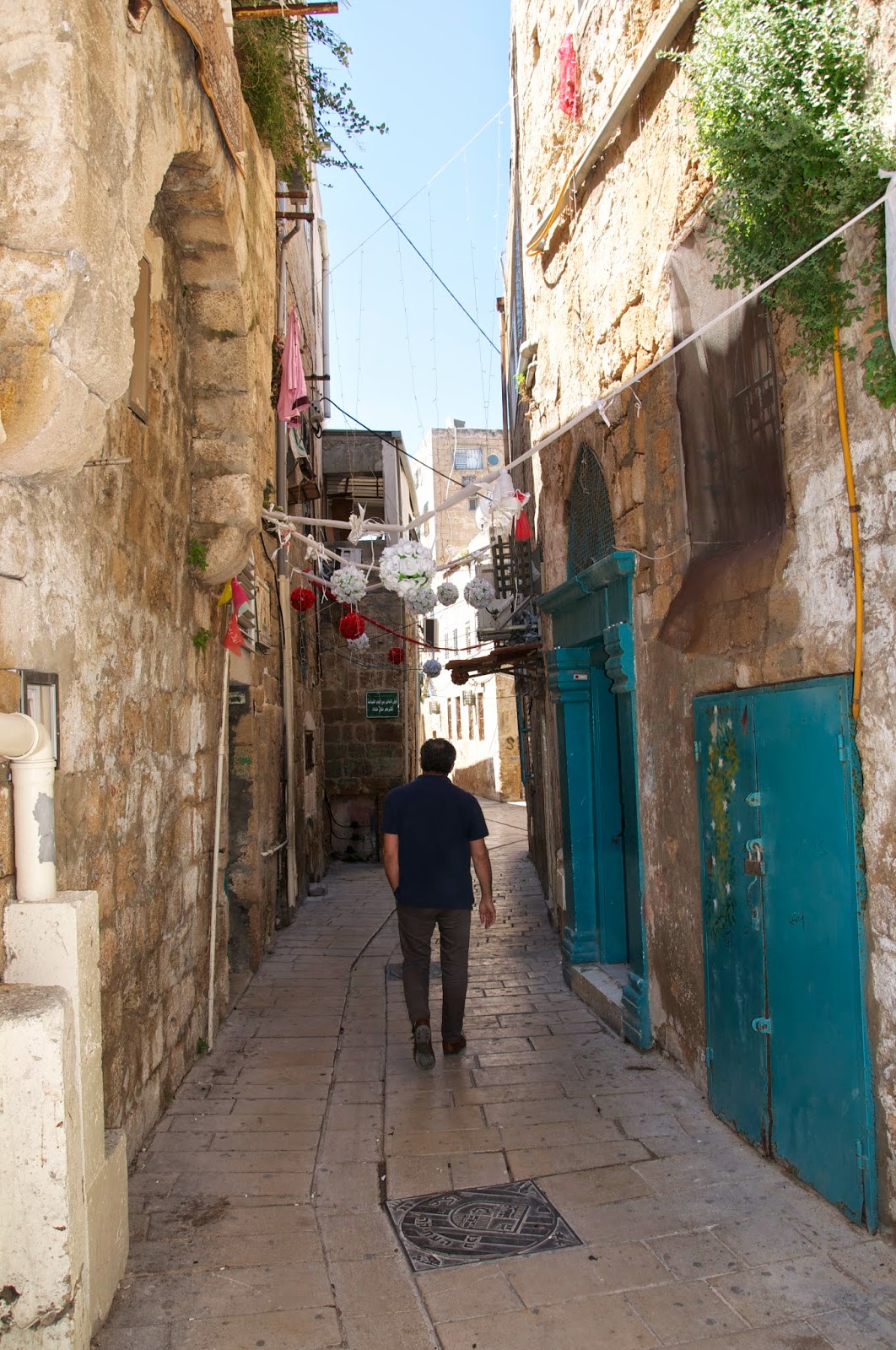 |
| Eleventh century Acre |
 |
| Khitam's brother, Wahib, who, when he was a boy... |
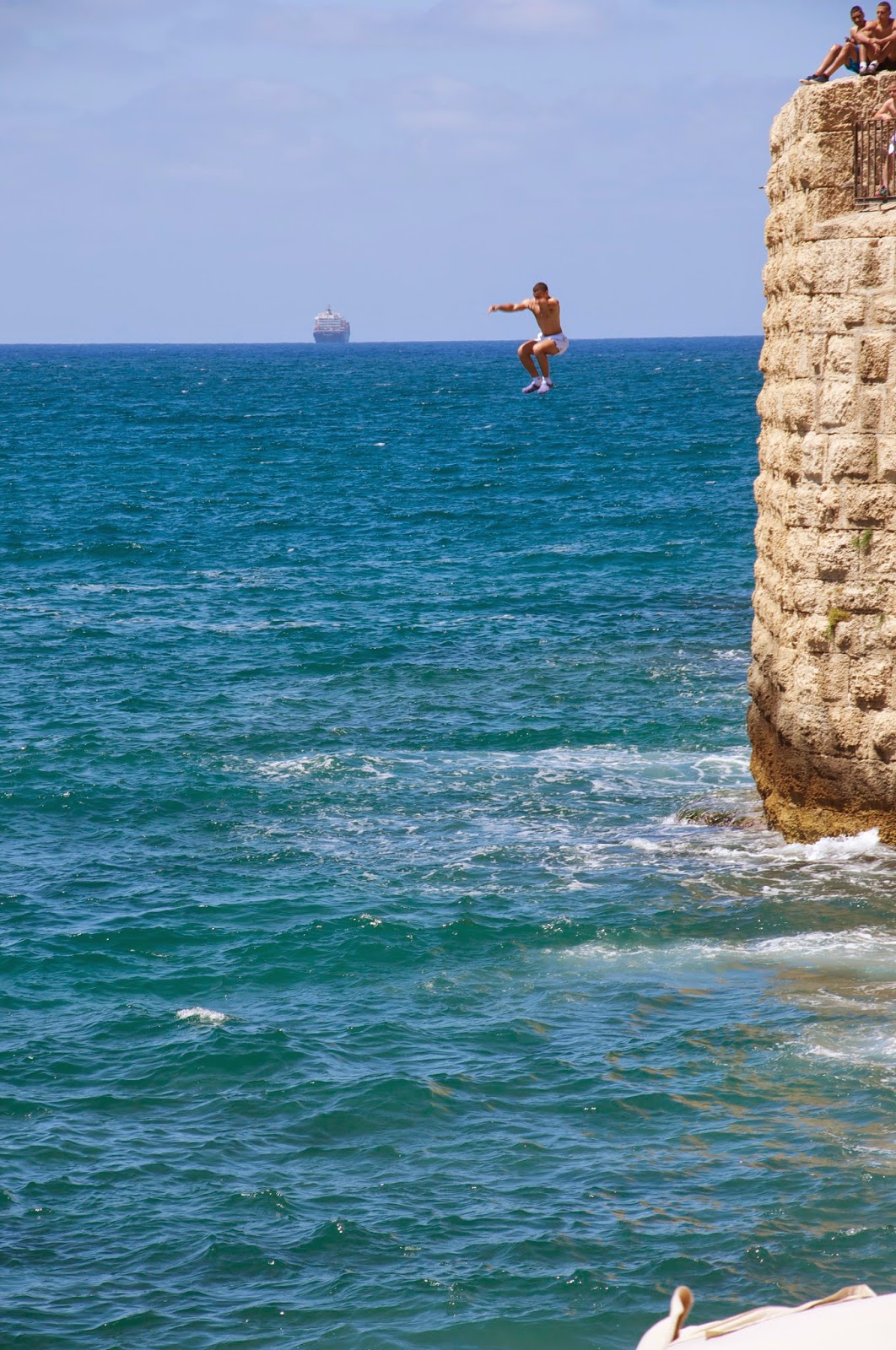 |
| …jumped off the wall, like this! |
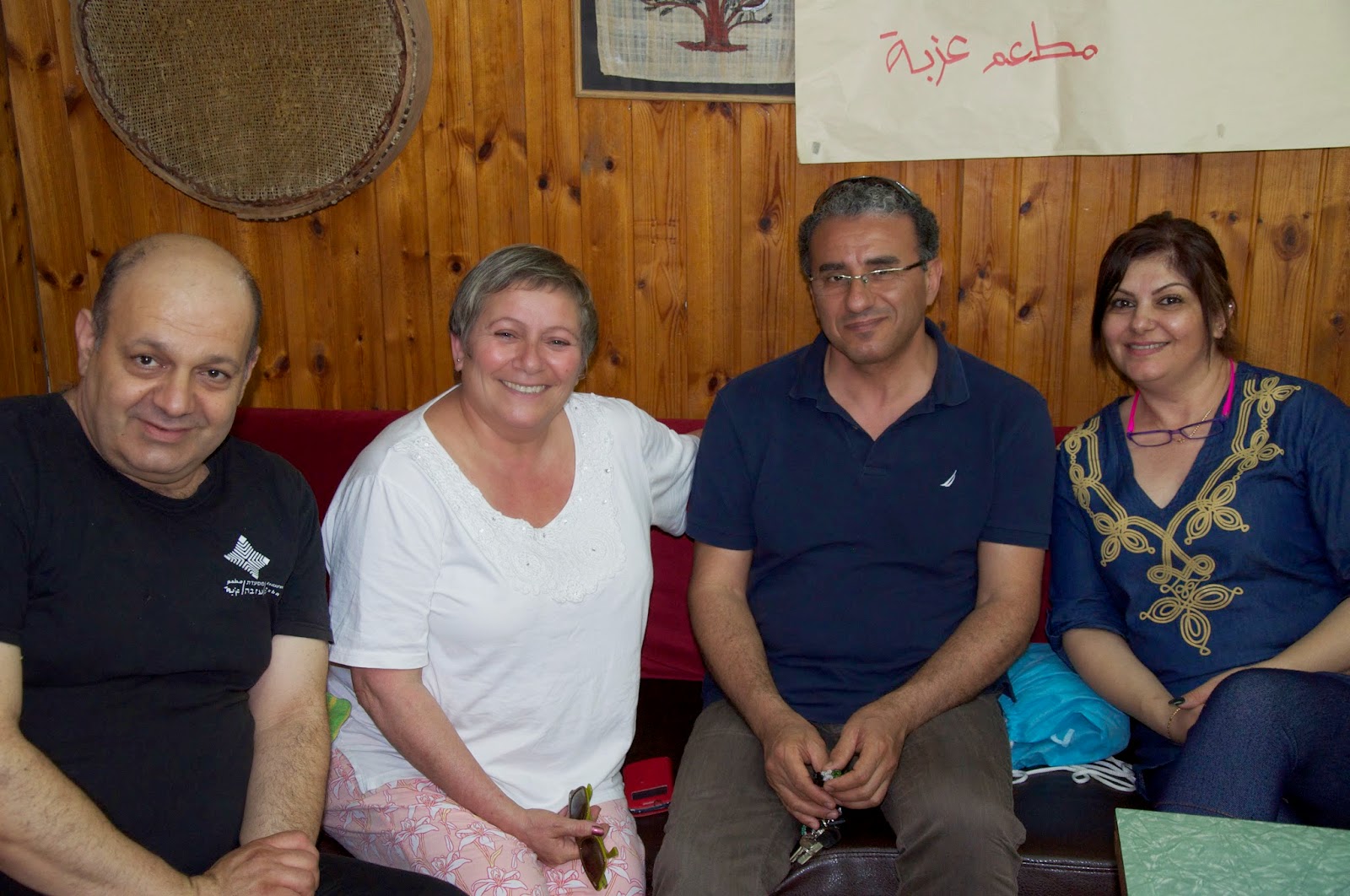 |
| Habib, Khitam, Ahmad and Minerva |
Friday, May 1, 2015
Jericho
I have probably already mentioned, and perhaps more than once, how generous Palestinian hospitality is. It's also filling, because it usually involves a meal. I am staying with Palestinian friends, so I am usually full. Fortunately, the food is very fresh. We just had a tomato dish with tomatoes Khitam and Ahmad bought in Jericho a month ago, and the tomatoes, which have been sitting on enclosed porch, are ripe and delicious and will be for several more days if not for a couple of weeks. Khitam hasn't cooked meat since I've been here; we've had chicken four or five times, fish once, and eaten in Jerusalem a couple of times. The rest of the meals are fresh vegetables, rice, lentils, eggs and no one is leaving the table hungry. I'm a guest and not allowed to cook or maybe they don't trust me!
Jericho is not a bread basket; it's a vegetable basket. The vegetables there are freshly delivered by farmers in the Jordan Valley, plentiful and inexpensive. And Jericho is where the parents of one of the boys I've worked with in Nasser's group at Husni al Ashab Middle School wanted to take Nasser and me. Nasser had told me that Hazzem and Nadia Showaki wanted to take us for an outing. I had a lot to do that evening, or I thought I did, so I told Nasser I had to be back around 6:00. When Hazzem and Nadia picked us up at the school, the first question for Nasser was: "When does Al have to be back?" Nasser told them and Hazzem said: "6:00?! We won't have time to go to Jericho!" Nadia asked if I could stretch it to 7:00 and I agreed, figuring I had tied, if not won.
So off we went to Jericho, a forty-five minute drive. Hazzem, who has his own construction business, speaks Arabic and probably Hebrew. Nadia, who lived for twenty or thirty years in Brazil, speaks Portuguese and Arabic. Each knows as much English as I know Arabic, so Nasser did a lot of translating and I used a lot of gesture and mime, punctuated with the odd Arabic phrase, and some of them were odd! We all managed. They asked if I'd been to Jericho, and I told them I'd been a couple of years before with Khitam and that I'd been when I lived in Lebanon in the 1960s and early 70s, the first time by motor scooter.
Then we were off to a reconstructed temple and some lovely gardens, a reproduction of a theater Alexander may have commissioned and an ancient Greek Orthodox Church. After all that, it was time for dinner and a return by 7:00 o'clock was less than unlikely. Dinner was half a chicken - "Don't you want a whole one?!" - a mezza of hummus, baba ghanoush, cabbage salad, garden salad, a spicy garlic dip, pickles, olives, Arabic bread, radishes and… After dinner, Arabic coffee, small and strong, some conversation with the waiter who seemed to be an old friend of Hazzem; in fact, most of the people we encountered seemed to be old friends of either Hazzem or Nasser. "Something sweet?" No room. No room!
Then, we were on our way…up and down a series of neighborhood roads to a building site. Hassem was near the end of the construction of a lovely house with a pool for someone from Oman; I'm guessing a Palestinian who made good money there. He showed us around the site for half an hour, pointing out the lovely touches that the owner had required and got. He invited me to jump in the pool, but there was no water in it yet!
 |
| Nasser, Hazzem & Nadya |
 |
| Dome of Greek Orthodox Church |
They asked me if I'd seen the mosque of Musa (Moses). I hadn't so that was our first stop off the road into Jericho. When we arrived at the mosque, Nasser greeted several people as old friends, some of whom seemed to be midway through a recovery of something. Nasser then told me that he had worked as a substance abuse counselor there. The ancient mosque had a space for counseling sessions and Nasser has been one of the counselors.
 |
| Interior of the church |
After a few more exchanges, we got in the car and an 8:00 o'clock return looked possible; well, it did until we got to the fruit and vegetable open market. We stopped and for about half an hour, Hazzem and Nasser and Nadia picked at and picked up fruits and vegetables. We finally left with a trunkful. While we were shopping, Hazzem had extended conversations with two or three people in the market.
 |
| Mosaic in church floor |
From there, we really were on the way home. They dropped Nasser at a bus that would take him to Bethlehem where he lives in a camp with his wife and four boys. Then delivered me to Khitam's around 9:15 after fun and friendly and filling evening with our Palestinian hosts. The work I had planned to do could wait another day, as long as I didn't get another invitation for a little outing and something to eat!
Subscribe to:
Posts (Atom)