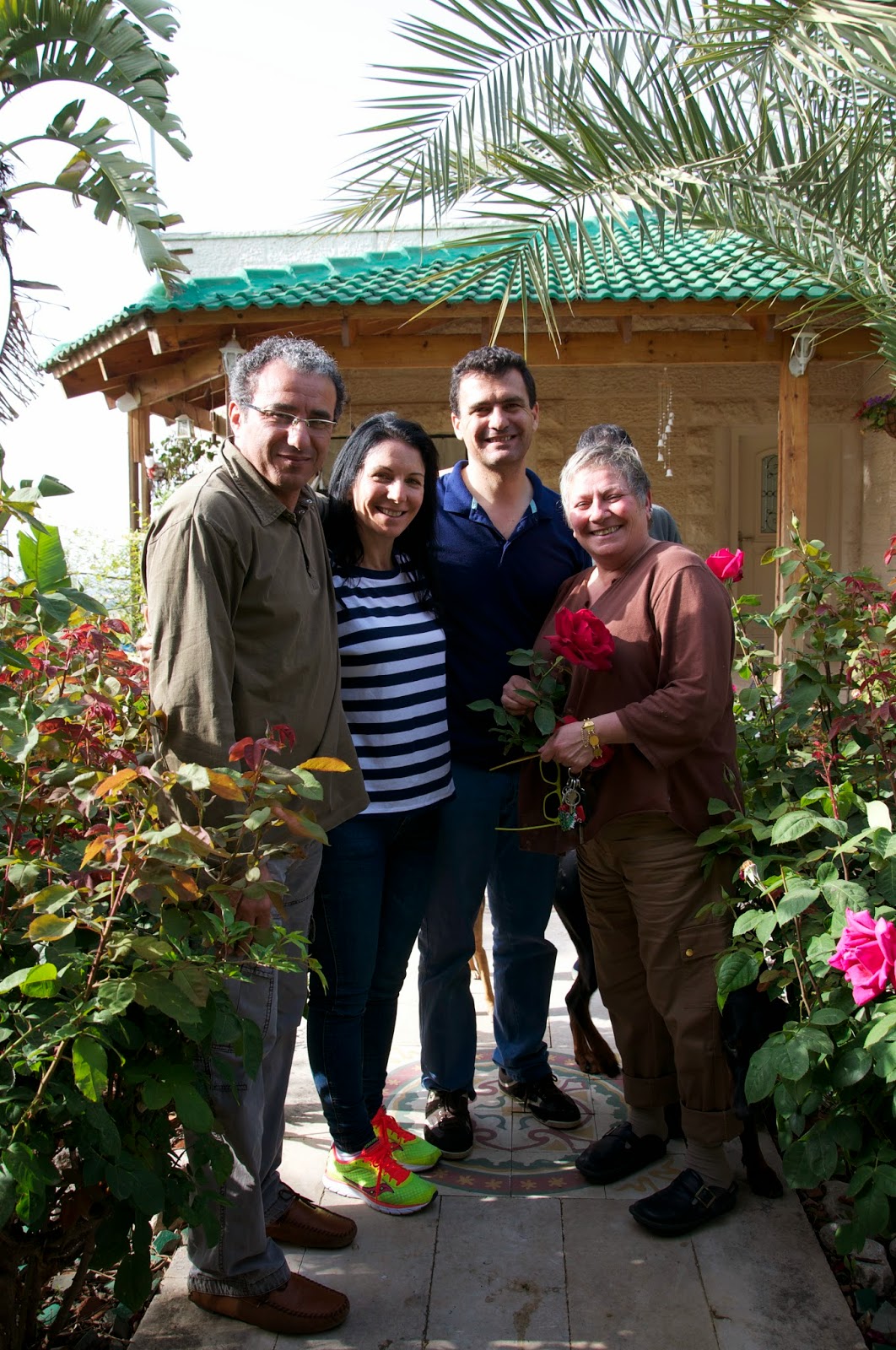
Wednesday, April 22, 2015

Back to Nablus

     Yesterday Khitam and I drove back to Nablus, an hour north of here, for her second workshop with kindergarten teachers and their principals.  Sunday, she focused on drawing and painting as a means to tell a story.  Teachers and principals made their own simple drawings, then worked collectively in small groups and finally worked in two large groups.  After each exercise, she talked with the group about what worked and what didn't.  She was good at listening and responding.
     The focus was on music and movement and theater.  After Khitam introduced the workshop, I told an Armenian folk tale, "One Fine Day," about a fox traveling through a forest.  It is also a Palestinian folktale that I wished I had learned.  I asked for questions and comments after telling the story.  They were kind; they liked physicalizing the story; liked the way facial expressions and changing voices helped them see the different characters.  We talked about storytelling and kids, ways to use stories to get them involved and then Khitam took over.
Khitam with some of the teachers and principals
     She started with music, putting out simple percussive instruments, many for children, plus a couple of Arab drums.  The teachers sorted through the instruments, trying them, putting one back and taking another, deciding on one and then looking for another.  Before long, everyone had an instrument, and Khitam told them to experiment with sound.  The result was first class cacophony and everyone knew it.  Now they were into it.  Khitam told one to start a simple rhythm, then told the others to join in.  She went around the circle until everyone had a chance to lead a rhythm symphony.  When one had trouble starting a rhythm or started one that was too complicated, she helped without imposing a rhythm on the group.  The enthusiasm in the room once the circle found its groove was palpable, and the teachers could feel just what their students will feel when they do this exercise.  Next was singing.  Khitam asked them to sing some of their favorite songs.  All the songs they chose were Palestinian folk songs, nothing new and popular.  But they sang the folksongs with gusto, and whenever they all knew the song, they rocked the room.  Sometimes one of them would know more verses and would lead while others joined in, and again, the room was rocking and rolling.  Their enthusiasm was infectious and I held back from joining in only because I was there as a visitor and the only male in the room.
I've got rhythm!
     After the songs, Khitam asked me to introduce some theater exercises.  Like Khitam, I had them do the exercises I wanted them to consider doing with their young students.  We learned how to make statues and then sculpted characters from the story.  One of the older principals suggested it might be necessary to do some simple exercises leading up to statues to get their kids used to the idea.  Then we made pictures or "polaroids," group statues illustrating the story.  They were hesitant at first but soon were joining in with enthusiasm.  I talked about making cartoon strips of the story, using polaroids; or having one group do a polaroid of one part of the story, another group of another part of the story; even having each group tell the whole story using polaroids that illustrate the high points of the story.  Then our time was up; three hours had passed quickly.
     The teachers were eager participants and learners.  Clearly, what Palestinian schools need is support.  If teachers here have an opportunity to learn new techniques, new ideas; if they have an opportunity to use new materials, they are eager to learn and to change.  What stands in their way is a lack of these opportunities and a cumbersome bureaucracy, like most bureaucracies.  In my encounters with Palestinians at work, I am impressed with their eagerness to change if they see any possibility for meaningful change.  Too many are out of work; too many are underpaid; too many held up by untrained for new work, but they're eager to learn.
Outside shower
     On our way back from Nablus, Khitam headed inland and took us to a site that reminded me of Zahleh in the Beka'a Valley in Lebanon.  Way back in the 1960s, we would drive over the mountains from Beirut to the Beka'a Valley in then peaceful Lebanon.  There, by a mountain stream in the town of Zahleh, outdoor restaurants would be packed with families on weekends.  Meals were large: hummus and baba ghanoush, tabouleh, bread, olives; then fish or chicken; then lamb or beef - maybe kabobs, maybe raw, maybe made into patties.  For desert, fruit and strong Arabic coffee and sweets if you had room.  Then the men and occasionally a woman or two, would smoke a narghile while the children played and mothers chatted.
     Our destination on the way back yesterday was similar.  Waterfalls tumbled down the rocks beside the road and cafes were tucked into the side of the steep incline that climbed from the road.  Outdoor markets selling pottery, baskets and kitsch from China lined the road.  We climbed several stairs to a cafe half way up the incline where we had tea and Khitam enjoyed a narghile while the water tumbled by.  On a hot day, it was a treat.  By summer, the place will be packed.


Monday, April 20, 2015

The old city

     First, a correction or addition: the title of the post a couple of days back is: "Kanafeh and pizza in Nablus."
     It's another beautiful day on the edge of Jerusalem.  Yesterday I spent most of the day in the old city in East Jerusalem.  Like so many sites in this part of the world, the old city is built over several older cities, including the Jerusalem Christ would have known.  The current Via Dolorosa (Way of the Cross) is at least ten feet above the route Christ apparently carried the cross.  The old city you wander in today is a late medieval city, I think.
Samir Turman, Al,  Dr. Khalad Hammad & The Dome of The Rock
Rafat
     Before exploring the old city with Rafat, a twenty-seven year old Palestinian friend who was in Maine, thirteen years ago, in our summer program at The Theater Project, I had a meeting with two men from the Ministry of Education.  After a few misunderstandings that may have been a result of Rafat's having to translate for me some of the time, or perhaps it was the timing of our visit, not long before the office closed for the day; at any rate, we were soon talking about my work here and clarifying what I am doing.  The Ministry has to approve any outside activity in the schools, so it took me a while to explain my work with Nasser, the counselor at a local boys middle school.  Once that was clear, they told me they needed a proposal to take to the Minister of Education; this will lead to a meeting with a higher-up at the ministry to get approval for my work.  Ah bureaucracy, often necessary and seldom simple or direct.
     Rafat has a motorcycle, a good choice given Jerusalem's traffic and we rode from his apartment to the old city on it.  He obviously knows how to drive in traffic, and though a couple of times I thought I might lose one or both knee caps, we made it to the Damascus Gate of the old city unscathed.  When Samir, one of the men I talked to about the work with Khitam, learned we had come by motorcycle, he was surprised "an older man" would ride on a motorcycle.  I think he saw it as appearing undignified, a risk most older men here would not want to take.  If he thought I might appear undignified riding behind Rafat, he should have seen me getting on it!
     Rafat is at one those places in his life when he has to make a difficult choice.  He has been offered a job with a bank in East Jerusalem, a job that is a step in the right direction for improving his work status and making himself eligible for better jobs, but it involves a cut in pay, and he isn't making all that much now.  In order to make ends meet, he will probably have to work a few nights a week if he takes the bank job and he is willing to do that.  I think he'll take the job and begin to move up.  He is bright and a hard worker, and I'm sure he's reliable.  He has his BA in business after taking a couple of years off to learn Hebrew so he could attend the Hebrew University in Jerusalem.  The choices he has to make are similar to those of young men and women in the States with a couple of major differences: he is a Palestinian and right now all the good jobs are in Israel, which is okay as long as he maintains a residency inside Israel; and he has to decide whether or not to continue the process of acquiring Israeli citizenship.  He's figuring it out.
In the old city
     We wandered in the old city for hours.  I never get tired of it, though the crowds are tiring.  We stopped at the Church of the Holy Sepulcher, the spot where Christ was originally entombed.  It is a big church with a warren of additions belonging to a variety of Christian sects.  There was a large crowd waiting outside, and I'm sure a larger crowd inside.  After we left, we encountered a scene that is probably replayed many times every day: two men arguing about religion.  One, an American, was quoting the Bible and arguing that the other, a Palestinian shopkeeper, was just plain wrong.  The Palestinian saw the futility of arguing further so he conceded that each was entitled to his own opinion, but the American was not going to let go, so the argument raged on.  I think the Palestinian also saw that as long as the American argued so vociferously, he was unlikely to get much business from tourists who were passing.
     We stopped for hummus and foule, a bean dish originally popular with Egyptian peasants and eaten with bread, like hummus.  Rafat told me it was the best place for hummus in the old city and knew right where to find it.  I couldn't direct you to it without visiting it several more times!  It was small, like most shops and eateries in the old city, and simple: hummus, foule, Arabic salad and a couple other dishes, water, soda and mint tea with a tea bag to drink.  And it was good, very good.  It was the best hummus I've tasted in a long time.  The place was packed most of the time we were there.
     We saw the Dome of the Rock, Islam's third holiest site after Mecca and Medina, the golden domed mosque built over the the rock from which Mohammed is supposed to have ascended to get the word of Allah which became The Koran.  The Dome of the Rock and the Al Aqsa Mosque are built over the site of the Temple of David, sacred to Jews, so it is a contentious site.  As a result, tourists are only allowed to view the two mosques at certain hours, and to view them, it is necessary to enter via the "Wailing Wall," the foundation of the Temple where Jews pray and leave messages.
Old city walls
     Rafat said, often searching for the word or phrase in English that is better than he thinks it is: "I am not so religious, but I think different religions are okay.  People can have their own religion and let other people have theirs.  Why they have to fight?  Over what?  A place?"
     When you're in the old city, you feel how important it is to Christians, Jews and Muslims.  Why not share it without fighting?  Why challenge someone else's right be there, to say his or her prayers?  Why not look at other religions' monuments and acknowledge different beliefs?  The old city cries out: "There isn't room for this kind of disrespect, hatred and fighting and all of them are antithetical to these three religions.  Rafat said: "Most of the wars now, they're because of religion, I think."

Sunday, April 19, 2015

photos from yesterday

     Here are some photos I didn't have time to put on the last blog.
Collaborating in Khitam's workshop

Happily figuring it out

"I don't think so…"

Khitam likes the work

"I think it's a…"

And VOILA!  It's art!

Kanafeh and pizza in Nabl

     Nablus is one of Palestine's largest and busiest cities.  North of Jerusalem and Ramallah, it was the major trading center of the area in several periods of Palestine's history, and when we visited it yesterday, it seemed once again to be a center for trade, sweets and hanging out.
     Khitam was teaching a four hour workshop in art therapy to fourteen kindergarten teachers from schools in the area, preparing them to use the Artbus.  Ah, the Artbus…  A few years ago, when she was working on her Masters Degree in Creative Art Therapy at Lesley in Cambridge, Khitam had a dream of driving a bus around Palestine, a bus full of art materials and small tables and chairs.  She would take the bus to villages where schools could not support an art program for the children.  They would come running out of the school with their teachers and do art with her.
     Last year, after three years of fund raising and telling people about the project, it became a reality.  A Palestinian bus company donated a bus, painted and configured to her specifications.  A local NGO came up with funding for the first year's work, and soon Khitam was traveling to villages and teaching art to primary grades and teachers.  The dream was active and it worked, and it continues.  Part of the grant money has supported a driver for the bus, essential to Khitam's being able to do her work and not worry about getting a bus driver's license, driving the bus all over Palestine, finding and executing parking and figuring out where to keep the bus.  
     Now, after a year of traveling from village to village in the bus to share art with children and their teachers, she has begun training teachers to use the bus without her.  The driver will go to village schools and to schools in cities where teachers Khitam has trained to use the bus will do art with kindergarten and primary school students.  "This way the bus can reach more students.  Sometimes I will go with the bus, but if I train lots of teachers and if we get more funding for the bus, more teachers and do art with more students!"
     So, back to Khitam's workshop with the kindergarten teachers…  Many, perhaps most of the teachers she was working with yesterday did not know each other.  They came in pairs, a teacher and her principal, so seven village schools were represented.  Khitam started by introducing me and asking if they minded if I stayed and if I took pictures.  They gave their okay.  I watched most of the time and then took a few photos.  After introducing me, she talked with them about the work, the importance of art for kids, the fun of it and its educational and developmental value.  Then she introduced the teachers to the work, having them do all the tasks she would do with five and six year olds.  It didn't take long for the work to catch on and take off.  The teachers worked alone, in pairs and in larger groups, making art, solving problems using art, telling stories with group paintings.  Before the end of the workshop, the teachers were fully committed.  Khitam talked with them about problems that had arisen: sharing ideas, reacting to your idea's not being chosen, listening to others.  The discussion was lively and Khitam kept it on track, enabling the teachers to learn not only about making and using art but also about resolving disputes and misunderstandings.  It was a terrific workshop.  There was much discussion I didn't understand because my Arabic is limited, to put it mildly.  Still, it was obvious how engaged the teachers were, how eager they were to learn and how much fun they were having.
     After the workshop, we drove into the downtown which was swirling and honking and pushing and shoving with people shopping, teenagers talking and hanging out, people eating ice cream, parents pushing strollers and people eating kanafeh.  Ah, kanafeh!  I first had it when in Beirut about fifty years ago.  It is a soft cake, a little like corn bread but thinner, richer and sweeter; it is in a shallow pool of a syrup that is somewhere between sugar water and maple syrup.  It is rich and delicious and clearly the most popular dish on the street where we bought ours.  The shop was small and packed.  People were buying to take out, eat in, eat outside the store, and as soon as a seat came available, it was filled.  We found seats, ate our kanafeh and were barely out of them before they were filled again.
     To top it off, last night, after a visit to a wonderful organic food project I'll write about tomorrow, Khitam asked if I wanted to go into East Jerusalem for a beer and a pizza…maybe she said "pizza" and I suggested beer!  So off we went to a popular restaurant on a narrow side street - like many streets in East Jerusalem - where we found a free table and had a Greek pizza that was very good and a mug of Taybeh beer, Palestine's favorite.  A tasty finish to a full day.  I'll send photos tomorrow or later tonight.

Friday, April 17, 2015

Latroun, wine and history

     Friday, a day of rest and prayer for Muslims, so traffic was heavy driving into Jerusalem as the faithful headed for prayer and others, perhaps also faithful, headed for the country.  We were headed for Latroun, also spelled Latrun, which is about an hour's drive south of Jerusalem.
     Latroun is the site of a Trappist monastery that nourishes the spirit and wine lovers' taste buds.  It is, like so many places here, a site with a rich history.  As we drove further south of Jerusalem, traffic thinned a little, and when we turned off for Latroun, we left the traffic behind.  There is no village of Latroun; it is a monastery, that's all, and that means it is quiet, a welcome change from Jerusalem and the highway.
The chapel
     Latroun probably goes way back in history; no place around here has only a present.  The Trappist monastery was founded in 1890 by the French, Germans and Dutch.  The Trappist order usually means silence and in their case, wine, which leads me to believe it was primarily the French who were behind the monastery.  During the First World War, the Ottomans closed the monastery; in 1926, it was rebuilt and reoccupied.  After the establishment of Israel in 1948, Latroun was a part of Jordan until the June war of 1967 when Israel began its occupation of Palestinian territory which continues today.
     At Latroun, we met Khitam's friends Maysaa and Atiyya, two engaging and very different characters: Maysaa all energy, laughter and obvious delight in what's going on and Atiyya quiet, perhaps a little shy, and always ready to help.  We walked around the extensive grounds - 200 hectares - that are planted in olive trees and grapes.  There are probably also vegetable gardens to feed the monks but we didn't see them.
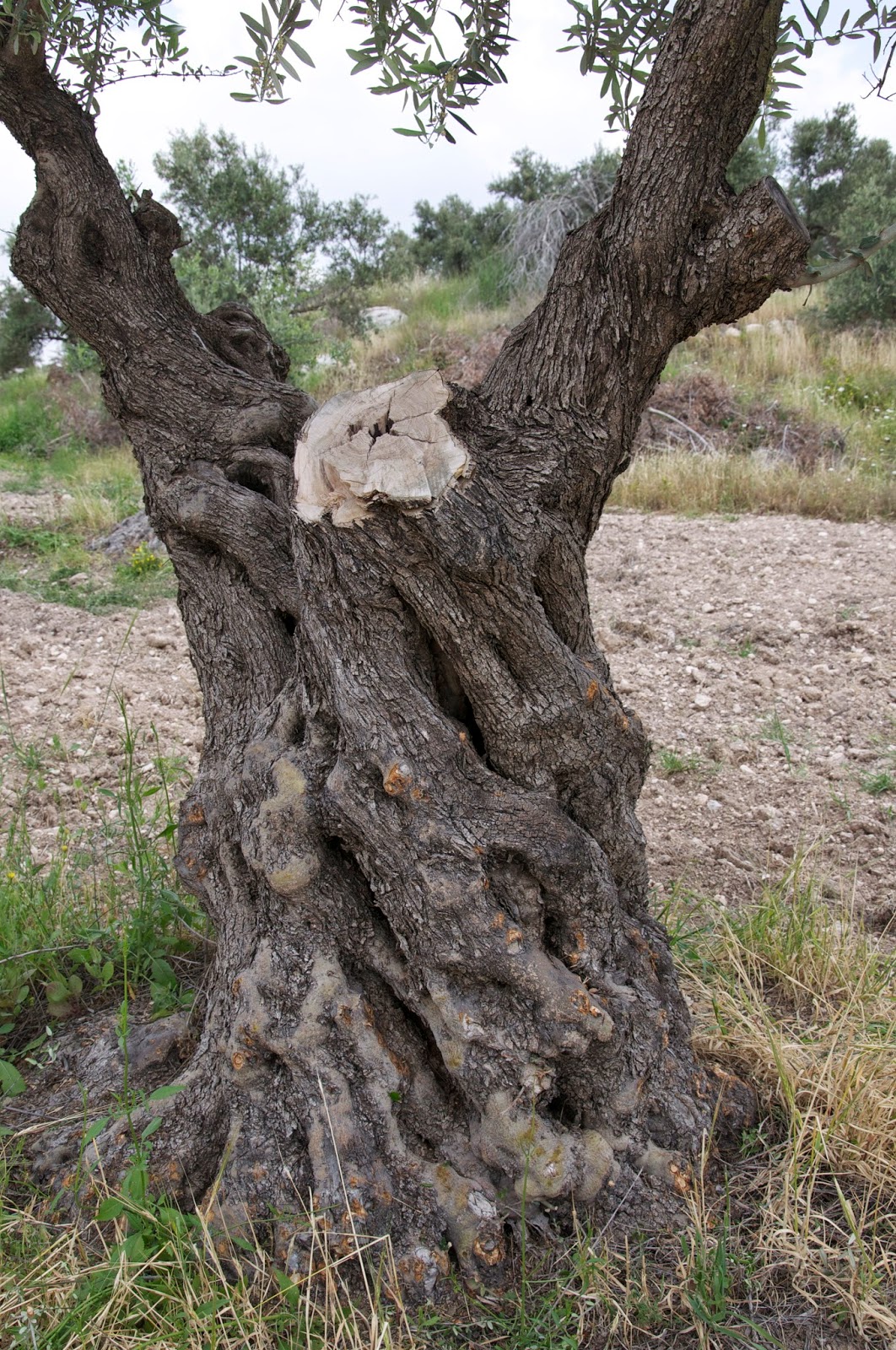
An old tree; look for the face
     Olive trees hold history in their twisted trunks and gnarly branches.  Some look like they will tell you something you'll only know if you are patient.  Many are over a hundred years old, so they have a lot to say but you have to figure it out…or wait.  Palestinians are wedded to their olive trees.  If they are destroyed by others, a part of the owner's life is lost.  Palestinians might have rewritten John Donne's "No man is an island entire of itself.  Each is a part of the ocean, a piece of the sea…" to say:  "No olive tree or farmer is an island entire of itself.  Each is a part of the other, a piece of man's spirit…"
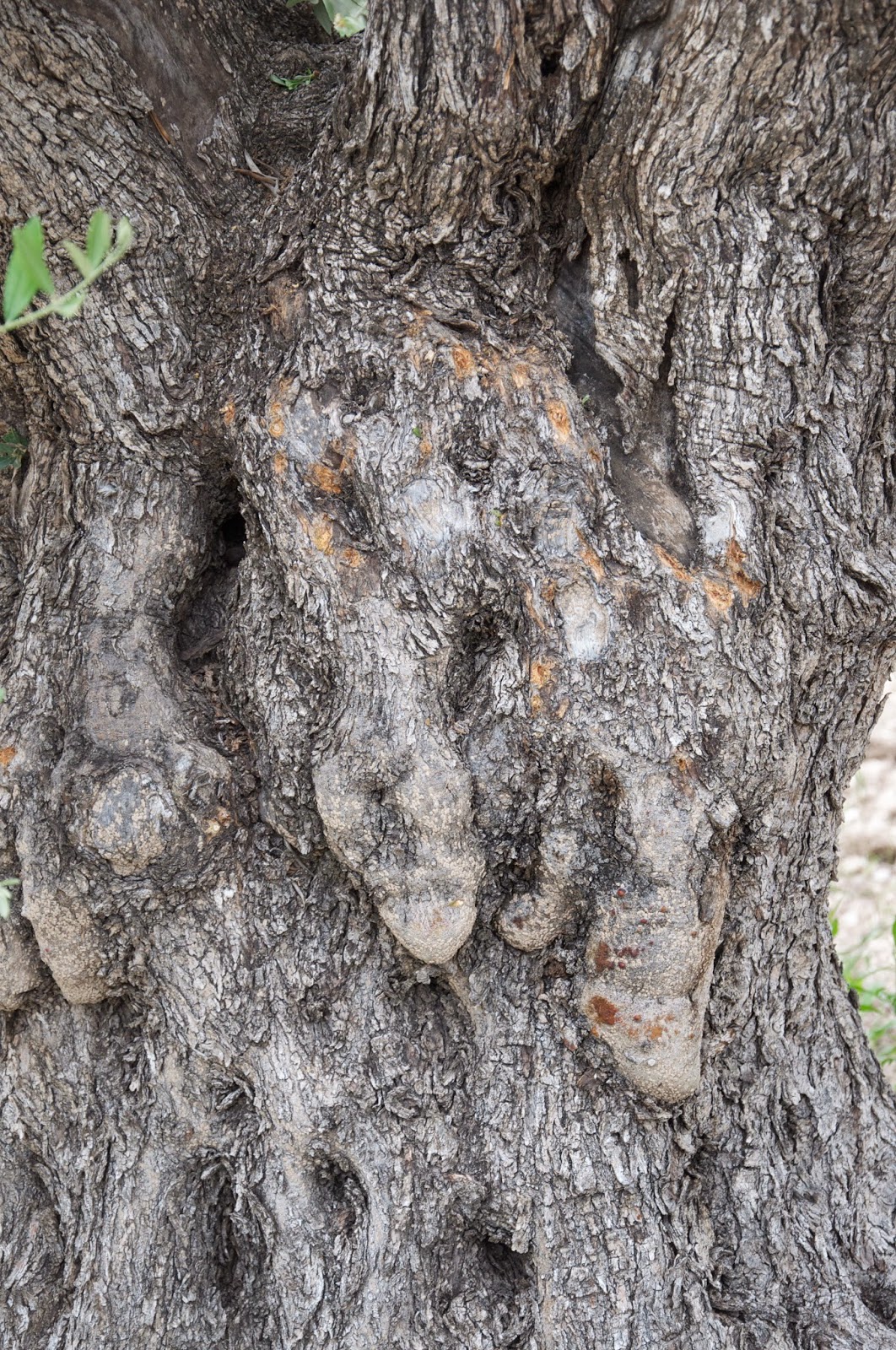
Can you see the eyes and nose?
     After our walk, we checked the monastery, but it was closed until later in the day, so we had our picnic on one of the cement picnic tables provided by the Trappists.  Khitam spread a cover over the table, Ahmad got the fire started and we began to unpack and set out the food:
mujudera, a lentil and rice based dish; leban (yoghurt); labneh, which is strained leban; zatar, a thyme based herbal mix especially good with bread and olive oil; black and green olives that Khitam and Ahmad had picked and prepared; foule, a bean dish Ahmad had made; plus onions, radishes and the reddest and wicked goodest tomatoes I have tasted in a long looonnnngggg time.  We began while Ahmad and Atiyya cooked chicken over a charcoal fire.  It was, as Templeton says in Charlotte's Web, a feast and, like Templeton, we gorged ourselves.  After the meal, Ahmad and Khitam shared a narghile (water pipe) and I checked to see if the monastery was open (not yet).
     Sated, as one often is after an Arab meal, we prepared to move on.  I bought a couple of bottles of wine to share later with Ahmad and Khitam, and then we drove to what the Palestinians call, "The Peace Oasis," a forest of mostly pine trees.  It could be in Maine, though the surrounding area could not be.  The forest is extensive, and though small as a "forest," is unlike any wooded area I've seen in Palestine, Lebanon or Syria.  We stopped to wander; Ahmad found wild thyme, which they call "zatar," and Khitam gathered pine cones for kids to paint in her art workshops.  While we were helping her, Maysaa told me about gathering them with her siblings and father when she was young and taking them home to decorate as Christmas ornaments.
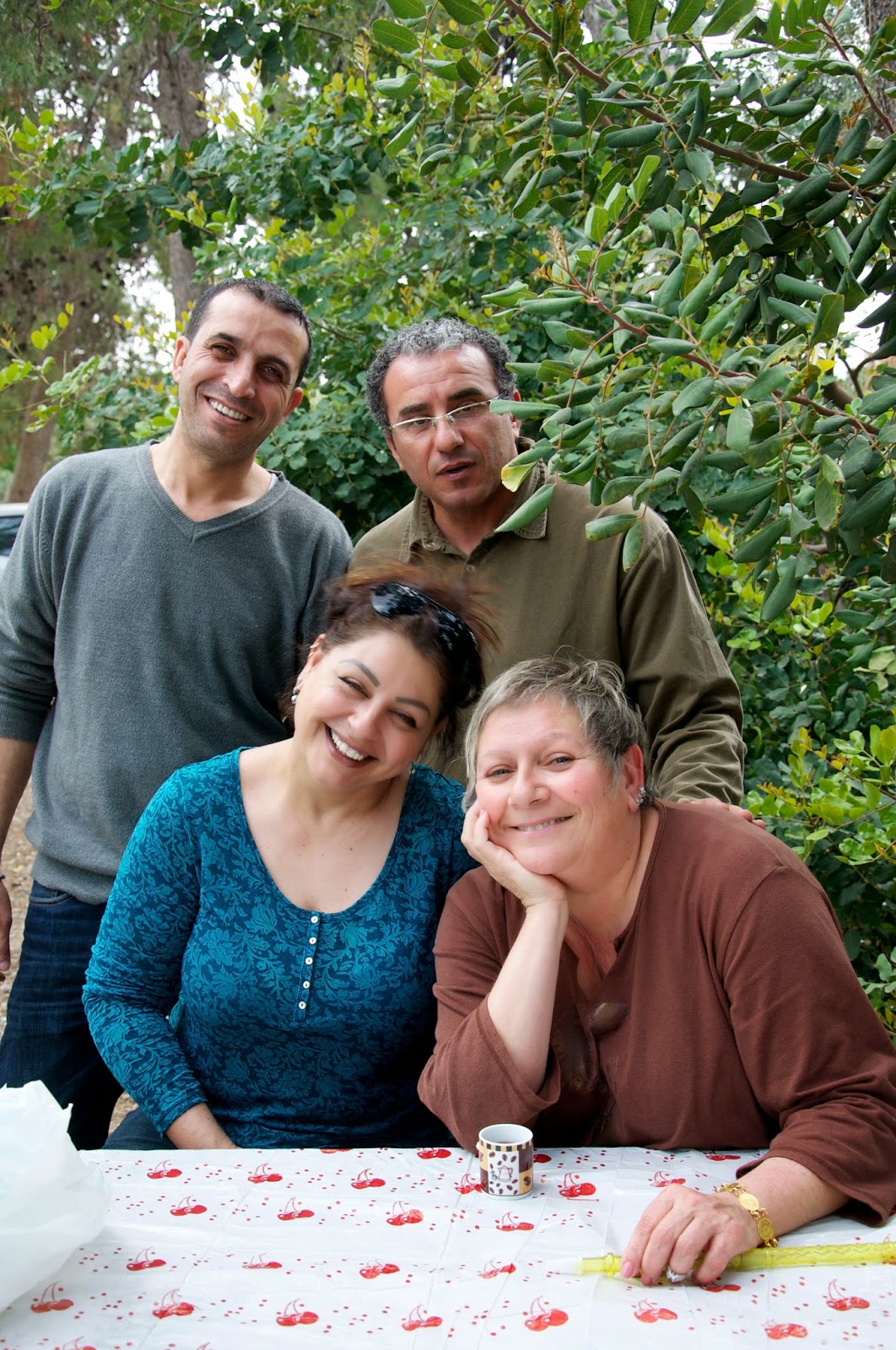
Atiyya & Ahmad, Maysaa & Khitam
     When we left, we stopped at Neve Shalom (Hebrew)/Wahat al Salam (Arabic), "Peace Oasis," a village community that is half Israeli, half Palestinian.  Khawla, Khitam's niece, and her husband Fouad live there with their two sons.  The village is an experiment in "living together."  It must have a fifty - fifty balance, which is maintained by a committee of community members.  There, you own your house but not the land; if you decide to sell it, the buyer must have the support of the community.  Khawla, who Khitam later told me is an established Palestinian actress, and Fouad have been there for thirteen or fourteen years.  They built a sturdy and attractive stone house with grass, fruit trees and flowers around it and two dogs to cause a commotion and guard them whether they need it or not.  It's a happy scene and the community is rare if not unique.  However, it does suggest that Palestinians and Israelis could live together, but perhaps only if they want to share the small area both claim.  If they did form a single state, it would be a state to be reckoned with in this part of the world and in international commerce and high tech.  Both are smart and ambitious people, and the Palestinians I know are warm and generous.  Maybe…maybe, some day…
Latroun monastery and vineyards
Ahmad, Khawla, Fouad & Khitam
     A correction to my last post: Khitam and I have known each other since the summer of 2001, she reminded me.  And a small world note for Brunswickians: at the airport in Istanbul, as I was waiting for Cotton to get off the bus that carried us from plane to airport, someone said: "Al Miller?  What are you doing here?"  It was Phil and Jane Creighton from Brunswick, whose daughter Kathy ran well for Brunswick High School's track team about twenty-five years ago when our son Tim was running the mile and two mile on the same team.  They were meeting Peter and Marcie McGuire - Peter was our family physician for years - and someone else from Brunswick to see Istanbul and maybe more.  Small world, indeed!


Day #1 in Palestine

    I arrived last night at TelAviv's airport on a Turkish Airlines flight from Istanbul.  Good flight, good food - they fed us constantly on both flights and I couldn't go to the gym!  Dinner was at 2:00 AM, brunch at 7:00 AM,  and dinner around noon on the flight from Istanbul.  Add seven hours to catch up with the time here.
     Khitam met us at the airport.  Customs was slow because there were several flights in at the same time but easy; no difficult questions and there was Khitam!  For those who don't know, Khitam is Palestinian, an old friend whom I met about twelve years ago through a mutual friend.  I invited her to come to Maine and work with me in our summer program.  She was doing similar work in Palestine.  She came for a few weeks that summer, returned for several summers and then decided to finish her BA at Lesley University in Cambridge, Mass.  Once she'd done that, she decided to continue in a Masters program for Creative Arts Therapy, which she completed, then returned here to work as a Creative Arts Therapist.  She now works with primary school teachers and goes to villages in Artbus to work with kids.  She does remarkable work and loves it.  She's my Palestinian sister.
     Although we had eaten every three hours on the planes, it seemed, when we got home in Adahya, where Khitam and Ahmad, her husband, live, she proposed a little food: fresh tomatoes, labneh with olive oil, zatar and olive oil for some fresh Arabic bread and delicious white cheese that is made locally.  An hour later, 1:00 AM, we finished talking and eating and went to bed.  Ahmad slept through it all.
     The stop in Istanbul, where I will return for four days on my way home, reminded me it was fifty years ago that I first went there.  Margy and I were living in Beirut, she was pregnant with Wendy, and her dad, Ray, had come to visit us.  They took a train to Istanbul and I was going to drive there to meet them.  When I got to the Syrian - Turkish border, I discovered I didn't have the necessary papers for our third-hand VW bug, so I couldn't get into Turkey.  I returned to Beirut and flew to Istanbul the next day.  In those days it was not difficult to get an inexpensive ticket for a flight on short notice.  As a result, I got to Istanbul two days before Margy and Ray and wandered around the city with a guidebook.  The two days were full of visual wonders and chance meetings.  The last time I was there was in 1998 with Tom Weaver, a teaching colleague who had come home to Ohio after a lifetime of teaching in Syria and Lebanon.  I'm looking forward to returning and rediscovering the city, which is three or four times the size it was when I first visited.
     The trip over this time was long but no longer than usual, just a different configuration.  The most excitement came with a head wound to a steward.  I don't know how he got it but assume he bumped into something.  The stewardesses gathered around him, two doctors who were passengers came to his aid, and we had an emergency medical scene played out which was better than anything on screen.  He was fine, but after they bandaged him up, he looked like he was swathed by medieval medical quacks.
     At the airport in Istanbul, we encountered a tour group from Texas going to the Holy Land.  Cotton talked with one of them and urged him to talk to Palestinians while here.  When people come to "the Holy Land," they tend to see only Israel and sites under occupation.  To get an idea of the whole scene here, it is important to visit "both sides."  Most people don't do that, and the result is that Palestinians are faceless people if they are people at all to Americans.
     Now that I am here, I am reminded how senseless this situation is, and how senseless similar situations are: Israel - Palestine, North and South Korea, Sunni - Shia, Turkey - Armenia…  What about one state here and in Korea; mutual recognition by Turks and Armenians, Sunnis and Shites and on and on.  I think also of negotiations with Iran and our failure to recognize how suspicious Iran must be of us.  It was, after all, the US with the British who overthrew Iran's fist democratically elected government.  Somebody has to break the cycle of suspicion.  Hmmm…
     Time for a picnic with Khitam and Ahmad and friends.  No photos this time and not much news.  I hope the blogs will get more interesting.

Wednesday, April 15, 2015

Leaving the river

     It's Wednesday afternoon.  I just finished a late lunch of a crabmeat and leftover roast salmon salad and a beer with Jean.  Now I'm "doing the drill," checking to see if I remember what Heather told me -  about posting on my blog with photos.  Can I do it?  I hope so.
From the deck, the river flows to the sea.
     I leave Boston late tonight on Turkish Airlines for Istanbul, then TelAviv, where my friend Khitam will meet me.  I'm connecting with Cotton Fite, a classmate from Williams, class of 1860, whom I knew  in passing but have gotten to know well since our fiftieth reunion, my first.  I heard he was interested in Palestine and had been making trips there.  We took a break from one of the celebratory - "What a great class!  How much can you give?" - dinners to talk for an hour or two and have since connected in Palestine and Maine.  One of these days I'll get to Chicago to visit Cotton and Diane in that vibrant city.  He and I will fly over together, spend some time together there, then connect again in Istanbul on the way home; I'm spending two weeks in Palestine, then flying to Istanbul for a few days.  Cotton and I are on the same flight from Istanbul to Boston, May 4.
     If I'm boring you, which I suspect is the case - I'm boring me! - skip the rest of this.  There won't be much more.  I have to do this test to make sure I can continue to blog from Palestine and Istanbul.
     I'll be working with Nasser, a middle school counselor I met and did some work with on my last visit.  I wrote about him then, a remarkable man who is doing very good work in a quiet way.  I'll work with him the first week I'm there, perhaps doing workshops with other teachers and counselors whom he has identified as people who want to improve Palestinian education, making it student centered.  I may also do some work with Khitam who is a creative arts therapist working with kids and teachers, primarily those doing early childhood education and with Abed, a friend from Bethlehem where he does extraordinary work with the community.  More on all of them while I'm there.
     The visit to Istanbul is a revisit.  I was last there in 1998 and visited often when I was living and teaching in Lebanon the decade after college.  The city is about four times the size it was then!
     I'll indicate on Facebook when I've posted a blog.  Those who aren't on Facebook and are interested, check every
couple of days.  If you get bored, stop checking!
     As Jackie Gleason used to say: "And away I go…"