Monday, November 11, 2013

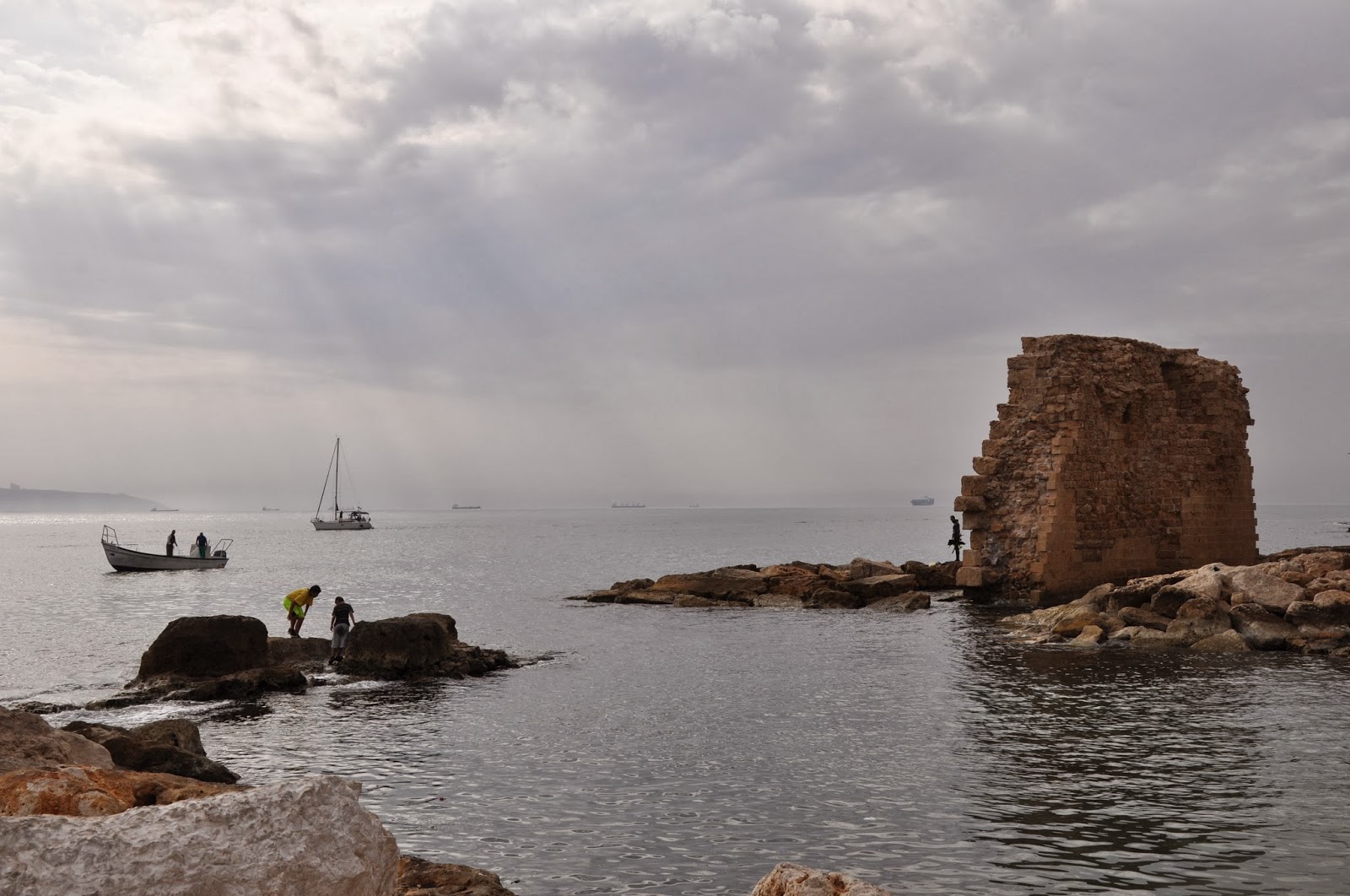
Medieval wall, modern barge
Tuesday morning, 12 November, Addahya, Palestine
Activity in the old harbor
   I'm posting some photos of Acre that I couldn't fit into last night's blog.  The harbor is Medieval, I think.  Wahib, Khitam's youngest brother - she is younger than them all - lives in an apartment there, where Khitam and her mother and two brothers lived after her father died.  The old city is Palestinian, with some Israelis living there.  The difference between old and new Acre is extraordinary and not surprising when you think of when each began, most of the new city being built in the last thirty or forty years, I think.                              
Off the coast
Smoke gets in your eyes
Old Acre with some new

 
Monday evening, 11 November
   The sun has set, the muezzins have finished their calls to evening prayer, the streets and the dogs are quiet; it's the early end of a good day.  Khitam went off this morning for a couple of meetings.  I did some work here, wrote the previous blog entry, then went with my friend Nasser to his boys middle school not far from here.  I did a workshop with a group of school counselors, substance abuse counselors, a teacher of hearing-impaired and deaf young people and a counselor who works with people in the psychotic ward of a hospital in Bethlehem.  A great bunch whom I'll meet with again tomorrow.
   Daily life may be changing in Adahya, this area.  It is supposed to have been the responsibility of the Palestinian Authority, but until recently, Palestinian police were not allowed in by Israel.  That apparently changed over the weekend and it has been "the talk of the town."  Because the Israelis would not allow the PA police in, there was no law enforcement here.  Drugs flourished; people shot off guns whenever they were celebrating; there was some violence; and young drivers squealed around corners and sped on straight-aways.  Apparently the Israeli government and the PA reached some agreement, because Friday, when Khitam and I were leaving, there were a lot of Palestinian police around.
    When we came back, we heard they had arrested fifty people for drug related offenses.  A visitor last night, a neighbor who seems "in the know," said he thought they had been planning this and that there were already PA agents inside gathering information on drug trafficking and other offenses.  Khitam agreed there had been agents inside for a while.  One of them is her neighbor.  Slower drivers would be a welcome change here.
   Where was I?  The weekend with Khitam's family.  First, some more corrections…at least one.  Khitam's mother was from Nahef, the village where her sister Zada lives and where we stayed.  Her father was from Acre, and that's where she grew up, so Nahef isn't really "her village."
Zada and Khaled

 
Naseba, picking olives
 Saturday morning, Khitam, Naseba, Khaled and I had a leisurely breakfast, the Palestinian version of a continental breakfast which would not have been the case if Zada had been there.  However, Zada wasn't there.  She had gone early to pick olives with Inas, her son, and her nephew.  We drove to meet them late in the morning.  They were busy knocking the olives off the branches with a long stick.  They stretch tarps under the trees, then hit the branches to shake the olives loose.  The olives on the lower branches, they pick.  Naseba and I picked olives off the lower branches of the tree they were working on until the long sticks got too close, but I'd have to say our contribution wasn't much.  Picking and gathering all day, as they do when they're harvesting the olives, is tiresome work.  Inas loves it and does it every year.  Zada told Khitam and me that he started when he was five years old, going out with his father and uncles to pick.  His girls are not interested, but I'll bet he gets his little guy

   By late afternoon, they were done picking.  They took the sacks of olives to the local olive press, waited their turn, then the olives were pressed and they came home with fourteen multi-gallon jugs of oil.  It's been a lean year, perhaps because of weather.  Inas said the good and bad years seem to alternate.  In a good year, they get as many as forty jugs!
   Olive trees are like middle aged and old men.  They get gnarled, a little stooped sometimes, and their leaves are small and shimmer a greenish silver in a slight wind.
   Picking olives is a part living for some Palestinians.  Zada is one of those and so is Inas.  They grew up picking olives.  Zada told me Inas first went out when he was five and stayed the whole day until the adults came home!  He urged his daughters to come pick last year and they agreed, but after two hours, they were done.  They sat in the car and read and listened to music and ate snacks.  Zada scoffed at this; she couldn't imagine not picking.  It's in her blood and in Inas the same way.  Maybe his little boy will go out with him in a few years, age five, just as he did.
 

The trees and the olives and the oil they give are dear to Palestinians.  When Israelis cut down or bulldoze their olive trees, I think a little bit of the owner dies.
   After taking Naseba home and Khaled to his brother Yousef's house, we went into the old city of Acre and walked along beside the sea.  The harbor is full of fishing boats, crowded into slips along the dock by Israeli yachts.  Boys stood on the rocks with long fishing poles.  A couple of snorkelers were looking to spear some fish.  Khitam and I stopped to have a late lunch at a fish restaurant.  She had salmon and I had calamari, both cooked to perfection in interesting and light sauces.  Of course there was also a salad and a small mezza of hummus, baba ghanoujh, olives, a slaw, bread…  Delicious!
 
Old city, Acre
We were a little nervous when we got back to Zada's because of course she was planning a big meal for everyone.  Inas and her nephew barbecued lamb, chicken and vegetables, enough to feed half again as many as were there.  There was salad, potatoes, hummus and I don't remember what else.  I got away with eating a little, though extra skewers of chicken were put on my plate when I wasn't looking. I was able to put them back untouched without incurring Zada's wrath.  Zuzu, one of her daughters-in-law said: "You don't eat meat, Al?  Why?  You don't know what you're missing," as she tore into another skewer.
   People stayed until babies and young ones were too tired to move or couldn't stop moving, running on automatic.  The house quieted down and Khitam and Zada had time to sit and chat a bit before going to bed.  I read a little, then gave in and slept.  The next morning, I was first up and just had time to make tea before Zada was up and soon  set to work organizing the olive oil.
   Another correction: I wrote "Zaza" in an earlier blog, instead of "Zuzu."  My apologies to Zuzu, a smart and busy mom whom I met at Khitam's wedding celebration three years ago.
 
   Sunday, we took our time preparing to leave.  Khitam, Zada and I sat down to a breakfast of warm hard boiled eggs; sliced cucumbers, tomatoes, peppers and onions; warm Arabic bread with zatar, fresh olive oil, leban (yoghurt) lebaneh (yoghurt with the moisture drained away) and jam; and two kinds of olives.  I may not be remembering everything!
   Then we said good-bye to Zada and headed back here.  On the way we stopped in al Birweh, which I wrote about this morning, I think, where Khitam's family lived before the 1948 war, as did the Palestinian poet, Mahmoud Darwish.
   Acre's old city, where Khitam and Ahmad had celebrated their marriage three years before, is always good to visit, although Khitam and I had perhaps our slowest and worst cup of Arabic coffee there along the seafront.  The view was wonderful and people were strolling and talking and smoking narghiles, but we picked the wrong little spot to order coffee.  Live and learn.  Khitam did get her narghile, but she said even that wasn't as good as usual.                                                                                                                                                        

Monday, 11 November, on the edge of Jerusalem
   First, a spelling correction from my last blog: the village Khitam is from that we visited over the weekend is Nahef, not Naher.
   It's another of those lovely early September sunny days though it's approaching mid-November.  With luck, the rains will start next month and continue through January.  This land needs those two months of rain.

Amira and Khaled
   The weekend in Nahef where Khitam's family is from and where her sister Zada and several nephews and nieces live, was full of food and family chatter and olives and olive oil and the sea.  On the way up, we stopped to pick up Khaled, one of Khitam's brothers and the only one who lives outside of Palestine; he lives in Houston.  Khaled recently retired from his job as bar tender and assistant restaurant manager in Houston.  His daughter lives in Japan with her husband and two small children - Khaled and his sister Zada and her son Inas flew to Japan for the wedding, no small feat from Palestine!  He is visiting for five weeks, a week of which is left.  Last year he didn't see his four brothers or five sisters at all, and now he's spending time with all of them.
Naseba
   We went to Khitam's sister Naseba's home for "lunch," which is usually a misnomer here, because lunch implies a meal that is not a feast; here, it is a feast!  Khitam's sister Amira was also at the house, along with her daughter and granddaughter and another daughter.  Eventually, her son arrived with his baby girl, Naseba's granddaughter, and his wife.  Naseba has divided her house and given two-thirds to her son and his family, keeping a couple of rooms and a kitchen and bathroom for herself.  Lunch was, well, by now, you know: kibbeh (a lamb dish), chicken and rice, two salads, and eggplant dish, leban (yoghurt), fresh Arabic bread and more.  We crowded around a table set in the small living room and ate and ate.  "Tfuddel, Al, kibbeh." (Al, have some kibbeh.)  "La'a, shookran." (No, thanks.) "Lish?" (Why?)  Khitam told them I don't eat meat, so instead of insisting I eat a plate full, they were content that I ate a little and said it was delicious, which it was.  Amira did put another serving on my plate when I wasn't looking, but I passed it on to Khitam and there were no protests.
 
Three generations: Naseba, granddaughter, daughter
We talked…well, they talked and I listened, understanding a little,  More people arrived and some left, and eventually we left to drive to Zada's house in Nahef, half an hour away.  Naseba and Khaled came with us.
Naseba's granddaughter and son
   When we got to Zada's house, people were waiting.  As always, the greetings were warm and profuse, with kisses on cheeks, three (kisses, not cheeks), and much: "How are you?  How is your family?  Thank God.  How is your work?  Praise God.  How is your health?  God is great…"  In Arabic, of course.  There was food, but we got off lightly.
   Zada's son Inas and his wife Hinadi and their youngest daughter, who is eleven, were there.  Inas and Hinadi have three daughters and a son who is a year and a half and full of piss and vinegar as little ones are.  The three daughters are in a terrific music program started by a man who wanted every youngster who wants to play music to have the opportunity, whatever the financial circumstances.  As a result, this program which he started offers scholarships to those who cannot afford it.  Inas and Hinadi's girls play violin, piano and guitar - I think I've got that right.
   While we were talking, I asked Hinadi if she had seen the video of Nigel Kennedy's version of Vivaldi's Four Seasons with Polish and Palestinian musicians.  She hadn't so I opened my laptop and we began watching it.  This concert was at The Royal Albert Hall, I think - or some large symphony space in London.  The musicians working with Kennedy are from a Polish orchestra he has developed and Palestinians from the Edward Said Conservatory in Palestine.  (I recommend the video highly; it's on You Tube.)  Kennedy is brilliant and an engaging clown and what he has done with this orchestra and Vivaldi is delightful.
   So, while we were watching, a fifteen year old Palestinian - they're all wearing Palestinian kafiyas (the head scarf) on their shoulders -got up to play a violin solo, brilliantly.  "That's Mustapha!" Hinadi said.  We know him.  He's in the music program the girls play in."  Soon, another younger Palestinian look-alike got up to sing/hum Arabic strains and Hinadi said: "That's his younger brother!"  Later, she identified the older brother, all three of whom are in the music program with the three girls.  Small world.  Watch the video.
   I'm off to do some teaching so I'll stop now and continue the visit to Nahef in my next blog.

Sunday, November 10, 2013

Sunday evening, 10 November, Addahya
   Back at Khitam's house on the "other side" of the wall and on the edge of Jerusalem, it's been another sunny day with weather like the best of Maine's in September.  We drove here this afternoon from Nahef, where we spent the weekend.  On the way back, we stopped at the Israeli village of Ahihud which was once the Palestinian village, al Birweh, where Khitam's family lived before the 1948 war when they had to flee.  We walked around the area where her family's house stood, found the remains of the mill where the olives were ground by a large stone (al ma'sara) to make olive oil, and then found one standing building, the boy's school, which her eldest brother attended along with the great Palestinian poet, Mahmoud Darwish.  Khitam called her sister Naseba who explained the location of the olive press and the school as if she had been there a few days ago.

One of two classrooms at the school in al Birweh

The old boys school in al Birweh
   But now, back to Alrowwad, where I spent two more days, Wednesday and Thursday, as did my friend Cotton.  Wednesday, Alrowwad is usually closed, so Abed had most of the day off.  We drove to the village of Beit Umar, where we met Jamal Maqbal and his wife and little boy.  Cotton was delivering a contribution to help Jamal pay for his heat this winter.  He had met Jamal through friends who had been involved in West Bank issues before he was.  Jamal's family lost their land in Palestine in the 1948 war; he has been in Israeli prison, and now the Israeli government has issued a demolition order for his house, the house he built.  He has taken it to court and received a delay.  He doesn't know what will happen if anything.
   There was tea, sweets, coffee, more sweets that we had to decline.  Jamal's wife is covered, meaning her hair is covered with a scarf and she wears a long dress to cover her body.  She speaks good English.  She studied computer science in college but as the mother of five children is occupied at home, and there's no guarantee she could find a job if she sought one.  She's a bright cheerful woman, busy at home but welcoming to friends and strangers with that Palestinian hospitality I continue to encounter.  While we talked, their two older boys came home from school.  The eldest, a senior, was in Maine last summer in Seeds of Peace Camp.  I asked how he liked it.
   "I loved it, loved being somewhere else, seeing new places, meeting new people.  When we had talks between Israelis and Palestinians, there were rules, that you had to respect the other people, no matter how much you disagreed with them.  It didn't really work.  People would get upset, yell and in the end, go back to their side.  But I liked meeting people from Afghanistan, Pakistan and Egypt, people who were dealing with the same problems we deal with here.  I had new experiences, saw new places, made new friends from other countries.  It was great."
   Abdelfattah does not work with Israelis.  He believes that Israelis who want to help make peace between the two sides should work with Israelis, their own people, to convince them.  There is a skewed view of negotiations between the two sides, discussions of the two sides, compromise between the two sides.  "Skewed" because one side is the occupier and has the power, the other side is occupied and has no power.  Abed is working to empower Palestinian youth and women so they can make good choices for their lives and work as he does to further Palestinian self-respect and rights.
   On our way back to Alrowwad, we stopped in Bethlehem at a little restaurant that serves mezza and chicken, that's it.  Abed said it's the best chicken in Bethlehem.  Now, chicken roasted outside over an open fire is common, but not this chicken.  It was succulent and the mezza was bountiful: hummus, baba ghanoush, a delicious garlic dip, two salads and more.  My hands were greasy, my stomach was full and before Cotton or I could ask for a bill, Abed had paid for the meal.  You have to be quick over here if you're going to share expenses with your host.
   Back to Alrowwad to teach a workshop and talk to some of the staff while Abed had a lively board meeting.  After that, we met Mazin Qumsiyeh, a biologist who taught in the States for many years and then decided it was time to return to Palestine, so he and his wife are back and he writes a regular blog on Palestine - Israeli issues and politics.  He is a small wiry man who talks rapid fire.  He is enthusiastic, outspoken and very interesting.  We went out for a snack before returning to Abed's and didn't have much time to spend with Mazin, but I had the feeling that if we had had time, we would have stayed there for at least another hour talking about Palestine.
   One more day teaching at Alrowwad, then we said good-bye to Abed and his family.  Nahel and the kids left in the morning for school in Jerusalem and Abed was off to France for conferences and then Amman before returning home later this month.  We drove into Jerusalem, had pizza and beer, then dropped Cotton at his hotel and came back to Addahya for the night.

Saturday, November 9, 2013

Sunday, November 10, Naher, near Acre
   Khitam has five sisters and five brothers, all but one of whom live in this area.  The sisters are Muheba, Naseba, Amira, Subheya and Zada; the brothers are Mohamed, Khaled, Yousef, Umar and Wahib.  Khaled lives in Houston, Texas but is here visiting.  A sixth brother, Mahmoud, died when he was young.  Khitam, at fifty, is the baby; all the brothers and sisters are older.
   Tuesday, after my Monday evening arrival, Khitam and I drove to Bethlehem.  A drive in occupied Palestine is not often a simple matter.  There are checkpoints, and one of  the worst, Qalandia, is near Khitam's home.  She is usually able to avoid it by going an indirect route when she is going to Jerusalem or in that direction, as we were, Tuesday.  By going around it, one doesn't avoid other checkpoints, just Qalandia, and that is worthwhile, worth the time saved, in spite of taking a longer route.
   Checkpoints and the wall make travel uncertain and often tedious for Palestinians.  There are traffic backups and drivers are delayed ten, twenty, thirty minutes or an hour in their travels, which makes appointments and meetings iffy.  Last year, Khitam had a regular teaching gig at a school that, without the wall, would have taken her five minutes to drive to; with the wall and an easy checkpoint crossing, it took her half an hour..
   We didn't hit a serious checkpoint until the edge of Bethlehem, where we had to show our passports.  The delay was brief, my passport more thoroughly examined than Khitam's.  Because she has a fair complexion, Khitam is often waved through checkpoints, the guards assuming she is Israeli and Jewish,  perhaps.
   Aida Camp is a cramped space with narrow roads that make Boston's inner city roads seem straight and wide.  With over 4,000 inhabitants, it is crowded, with houses, apartments and shops butting up against each other.  If you're new there and begin wandering, you could easily lose your way; there's little reason to the layout.  After all, it started as a tented refugee camp, which is now inhabited by second and third generation Palestinians.  Abdelfattah is one of those, though he no longer lives in the camp.
   Years ago, he decided children growing up in the camp needed an alternative to misery and anger.  He wanted them to choose life, not death either self-inflicted or by Israeli bullet or explosion.  To do this, he developed Alrowwad .  Its vision is: "A Palestinian Society free  of violence, respectful of human rights and values, where children and women are empowered on an educational and artistic level promoting self-expression and respect for human values and rights."  Abed speaks of "beautiful resistance, working to deepen the notion of belonging, volunteering, creativity and rights for youth and women, regardless of origin or religion…to create a comprehensive society using non-violent expression through education and the arts…building peace within Palestinians."
   It is impossible to summarize all Alrowwad does and what Abed hopes to do, but here is a sample of the objectives:
     - empower local communities, with a focus on youth and women, to develop self confidence and self-expression and a sense of belonging in "beautiful and non-violent ways," such as literacy and the arts;
     - break media stereotypes about Palestinians using performing and visual arts, international tours and by developing local and international support groups.
 An arts program provides training in dance, drawing, painting, music - including a choir - puppetry and games and activities with the Play Bus, which travels to Palestinian communities and camps to perform and teach.  In addition, a photography program "puts Palestinians behind the camera instead of alway s in front of it to show Palestinians and tell their stories through Palestinian eyes."  The program's philosophy toward women is that they are "the change makers in society."  Alrowwad strives to support women through programs through job training, physical fitness programs, training in traditional crafts such as embroidery and health education.
   There are currently facilities and training in computer literacy, photography, storytelling and creative writing.  There are plans for an expanded library.  Abed also wants to develop a school program that  integrates mainline students and students with developmental and physical disabilities; Alrowwad already has a support program for students with learning problems.  Finally, though I'm not sure the concept of "finally" exists for Abed, Alrowwad strives to be a green working space and encourages "roof agriculture" in Aida Camp.
   Tuesday afternoon, I did a workshop there with a combination of high school and university students plus a ten year old who was game for anything.  Some of them spoke English well, better than they thought; others were very hesitant.  Still, because the workshop focuses on imagination and improvisation, we could work together.  They were fun, not unlike a similar group would be in the States, other than the language.  We warmed up, did some improvisational and trust exercises, then, through a couple of improv games, began to create material.  There were several "stars of the show," but I have to say Abed, who participated, and the ten year-old were outstanding and quick to lead the others!  Two hours went by quickly.
   Abed drove Cotton and me to his home, in a village about ten minutes away.  The house, which took eight years to build, after three years to buy the land, is a beautiful combination of modern and traditional Arab.  Most of the furnishings are Palestinian designed, while the kitchen is a model of modern western design and the furniture that is not traditional Palestinian is the kind you'd find in many American homes.
   Abed's wife, Nahel, is a bright, tidy hard-working mother of five.  Her English is fluent, she is gracious and she has a lively wit.  The children - Kanaan, Adam, Ahmad, Rana and Sana - are bright and lively, well-behaved - my mother would have been impressed - and fun.  They were excited to see their father home, especially the two girls, and he to see them.  Khitam, who had stayed to watch the workshop, joined us with a bowl of ma'loubi she had prepared for me the night before, a delicious dish with chicken, rice and vegetables cooked together.  We sat down for a "light supper" of ma'loubi, eggplant and yoghurt, two kinds of rice, lamb, two salads and, would you believe, corn-on-the-cob; for dessert, we had kanafeh, a rich, syrupy traditional Palestinian dessert.  Nablus, a Palestinian village - probably a city, now - is famous for its kanafeh, but ours was from a local sweets shop.
   Lots of good talk after dinner and a long rich day.  Alrowwad is a remarkable program developed by a remarkable and generous man, now a good friend.  A Palestinian home is a center of love and hospitality.  No one goes away hungry, and if the hosts have their way, no one goes away until he or she has to leave.
Saturday, 9 November, 6:00 PM in Acre, Palestine/Israel

   It's time for evening prayer.  I'm sitting on the floor in a child's bedroom in Zada's house in Nahef, a Palestinian village near Acre.  This is where Khitam's family is centered, though I sometimes think she is their center, she, the errant one.  A little background for those who don't know Khitam.
   Khitam Edelbi is a Palestinian friend of mine.  We met through a mutual friend, Claudia, who lives in California.  Claudia taught for a year at International College in Beirut, Lebanon, in the very early seventies, before Lebanon's civil war began.  I was teaching there, so we met.  Decades later, I called her, and as we were catching up on what each other had been doing for the past thirty years, I told her about my work in theater and education and she said: "Oh, I wish you and my friend Khitam could meet."  She told me that Khitam was doing creative and healing work with kids in Jerusalem using theater, so I suggested inviting her to come to Maine to visit our summer theater program for kids.  Khitam came for two or three or four weeks - I don't remember how long - we became good friends, and she returned for several summers.  That led to her applying to Lesley University in Cambridge to complete her BA which led her to stay on to get an MA in creative arts therapy which she did.
   Khitam returned to Palestine and began doing creative arts therapy with kids and teachers.  I began visiting her, doing some workshops where I could and observing her work.  She has developed an excellent reputation and is busy mostly working with teachers.  Whenever I get to observe her in action, I am wowed by her ability to connect very quickly with early education teachers who have had no experience with her work.  They quickly trust her and begin taking the kind of chances in her workshops that she wants them to help their students learn.  Khitam, my Palestinian sister, is a wise and witty friend and she is an excellent teacher.
   Now, I am back in Palestine, visiting Khitam and doing some workshops.  The muezzin has finished his evening call to prayer, which was short - the long ones seem to come in the morning, around 4:30, but I have become inured to those after being wakened the first couple of nights here.  I'll return to Zada's house and Khitam's family, but I want to go back to my arrival.
   I flew over on Alitalia, which I thought might offer good Italian food to compensate for the lack of leg room in tourist class.  I was wrong.  I make better pasta and serve better Italian wine!  I flew out of Boston to Rome, sleeping at least two and a half hours en route.  I had about the same amount of time in the airport in Rome to wander in a daze, order a coffee and get just that, coffee, instead of expresso which is what I thought I'd get.  I didn't know Italians served "coffee."  I recommend expresso, based on the coffee I had.  It was okay but when in Rome…  My flight to Tel Aviv was without incident and Khitam met me at the airport, where I cleared security and customs without incident.
   In an hour, we were at Khitam's house - half a house - where she and Ahmad live close to THE WALL, which you see from her house, two blocks away.  She fed me too much food - it's always too much food…my favorite comment on food here is from Lawrence in The Seven Pillars of Wisdom.  He's talking about an Arab sheikh named Auda Abu The (I'm not sure of the transliteration; his name is pronounced Owduh aboo tie): "His hospitality was overwhelming except to the very hungry," or words to that effect.  I went to bed around 11:30 which was 4:30 in Arrowsic, Maine, so even though I was tired, my body refused to sleep for a while, and not long after it did, the muezzin in the mosque near Khitam's decided it was time for me to wake, so he called: "La illa…"
   Tuesday, Khitam gave me a ride to the Aida Camp for Palestinian refugees in Bethlehem.  Over 4,000 people live in the camp, about half of them under 18, in an area with no green space.  It's not a tent camp, though it started as one.  It has been built into a small village.  On the edge of the camp is The Alrowwad Cultural and Theatre Society (ACTS), founded in 1998 by Abdelfattah Abusrour, a remarkable man.  My friend from college, Cotton, was there with Abed; Cotton was doing some filming for a short film he's making on people in Palestine.
  Abed grew up with his family in Aida Camp.  His family had fled there from Palestine.  A bright boy, Abed became interested in theater and painting and writing at an early age.  He also did well in school and eventually went to Paris to pursue and gain a Ph.D. in biology.  Even there, while studying, his interest in the arts continued and he and some fellow students developed a theater.  After graduation, he worked as a biologist for a while, but he missed the arts, especially theater, and Palestine, so he returned to Aida Camp in 1998, found a job with a pharmaceutical company and a teaching position with Bethlehem University and founded Alrowwad, which began in his parents' home, where he was living.
Al, Abed and Cotton
   Eventually, he and Alrowwad moved out of his parents' house.  He began to build a home for the program and has managed to raise enough funds for a building on the edge of the camp that houses pre-school programs, a library, a computer lab, a photography lab, a theater space for theater and dance and Palestine's first program for women's fitness.  He is now trying to raise funds to replace worn out computers, expand the library and open up space for preschool education.  At the same time, he is touring in a new play about the Palestine - Israel debacle, and he is traveling to France to try to raise interest there in a creative partnership with Alrowwad and then on to Amman, Jordan for a conference on education and the arts before returning home later this month, where his wife, Nahel, an elementary school teacher and assistant principal in Jerusalem, and his five kids, Kanaan, Adam, Ahmad, Rafa and Safa will be eagerly awaiting him.
   As I was saying, I'm here at Khitam's sister Zada's house.  Zada and Zaza and her sister Hinadi who is married to Zada's son, Inas are in the kitchen working on dinner for who-knows-how-many and that worries me because Khitam and I had a good late lunch in Acre.  Maybe I'll find room for a bite or two!
They also serve who only sit and wait.

Sunday, November 3, 2013

I am leaving tonight for two weeks in Palestine and will be blogging while there, hopefully with photos.  Check it out if you're interested.  Al